Running a restaurant in 2026 is not just about serving great food and providing good service. Costs are rising everywhere. Ingredients are expensive. Labor is harder to manage. At the same time, customers expect fast service, accuracy in order processing, and flexible payment options.
Amidst this, many restaurant owners face this critical question- how do you reduce restaurant costs without hurting quality or overworking your team?
The answer is simple. A modern restaurant POS system plays a bigger role here than most people realize. It is no longer just a billing tool. It quietly controls waste, labor efficiency, and daily decision-making.
Let's break this down in a clear, practical way.
Why are Operational Costs So Difficult to Control Today?
Controlling rising operational costs is a challenge, but most restaurant owners do not realize that they do not lose money in one big mistake. Instead, they lose it in small daily leaks.
Overstaffed slow shifts increase labor costs when employee schedules are not aligned with actual customer demand. At the same time, food waste caused by over-ordering or poor inventory visibility leads to spoiled ingredients and unnecessary purchasing.

Accept, Process, and Profit with Ease!
Streamline Your Online Orders with Plum POS
Order errors, whether from miscommunication or manual entry, often result in free remakes, wasted kitchen time, and dissatisfied customers. On the administrative side, manual reporting and paperwork consume valuable hours that managers could otherwise spend improving service or training staff.
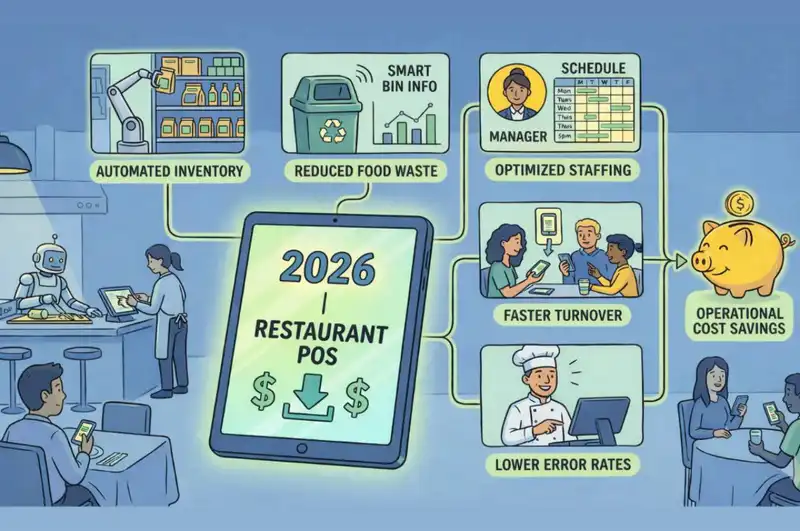
All of this adds up. This is why restaurant technology for cost savings has become a priority, not a buzzword, for operators in 2026.
Types of Restaurant POS Systems and Their Cost Impact
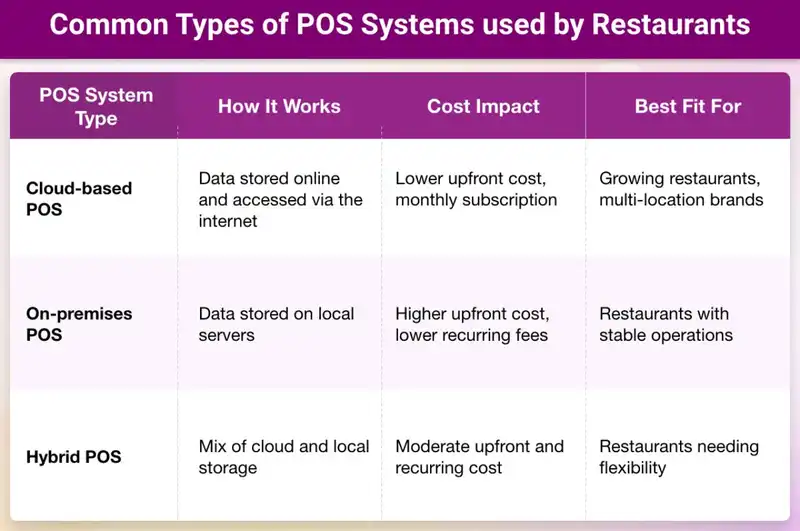
Not all POS systems work the same way. The type of POS you choose directly affects both upfront costs and long-term operational expenses.
Cloud-based POS systems are increasingly popular because they offer better visibility, easier updates, and lower hardware dependency. On-premises systems may look cheaper in the long run, but often increase maintenance and upgrade costs.
Choosing the right model is the first step toward effectively reducing restaurant costs.

From Click to Kitchen
Handle All Your Online Orders with Plum POS
How POS Software Reduces Food and Inventory Costs
Food cost is one of the largest and most unpredictable expenses in a restaurant. Without proper systems, owners often rely on estimates rather than facts
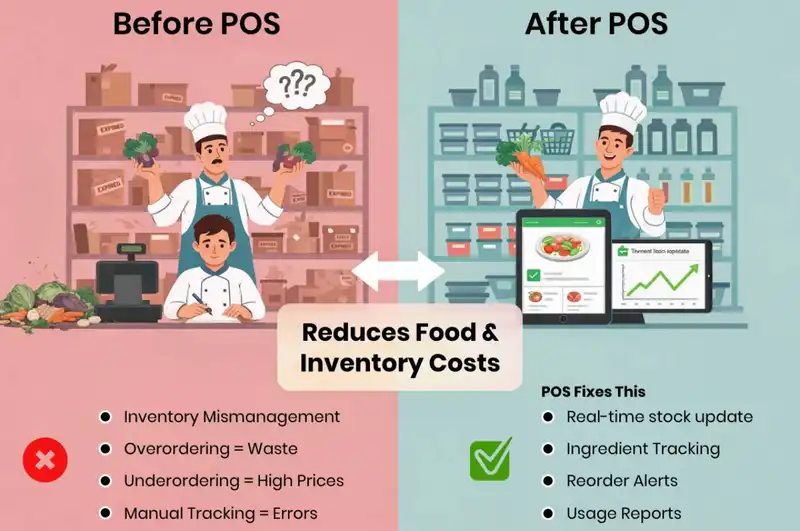
How Inventory Mismanagement Increases Costs
- Overordering leads to spoilage and expired stock, especially when perishable items are purchased in excess without clear demand forecasting. As a result, ingredients go unused, increasing food waste, and locking up capital in inventory that never contributes to sales.
- Underordering causes last-minute purchases at higher prices when essential items run out unexpectedly. These urgent purchases are often made from nearby vendors at premium rates, increasing overall food costs and disrupting planned budgets.
- Manual stock tracking creates errors and blind spots because handwritten records or spreadsheets are often miscalculated or forgotten to update. Over time, these inaccuracies reduce confidence in inventory data and make it harder to plan ordering and production correctly.
- No visibility into which items generate the most waste means businesses cannot identify problem ingredients or low-performing menu items. Without this insight, waste continues unnoticed, and opportunities to optimize portion sizes or adjust purchasing decisions are missed.
How POS Fixes This Problem
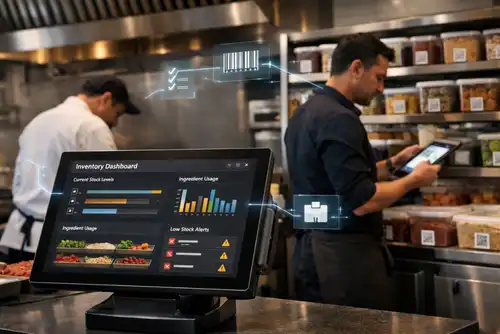
POS links every sale to inventory usage. When a dish is sold, ingredients are automatically deducted based on predefined recipes. This creates real-time visibility into stock movement.
Key POS software benefits for inventory control include-
- Immediate stock updates following each order guarantee that inventory counts remain precise and mirror genuine sales performance. This helps avoid unexpected issues during service and enables teams to make well-informed buying choices.
- Tracking at the ingredient level rather than merely at the item level offers greater insight into the consumption of raw materials for each recipe. This simplifies the management of food costs and highlights ingredients that are causing increased expenses.
- Notifications when inventory hits reorder levels inform managers prior to shortages or excess stock. These prompt alerts assist in keeping ideal inventory levels without frequent manual inspections.
- Reports comparing anticipated usage with actual usage reveal inconsistencies due to waste, portioning problems, or theft. This understanding enables companies to promptly implement corrective measures and enhance overall inventory management.
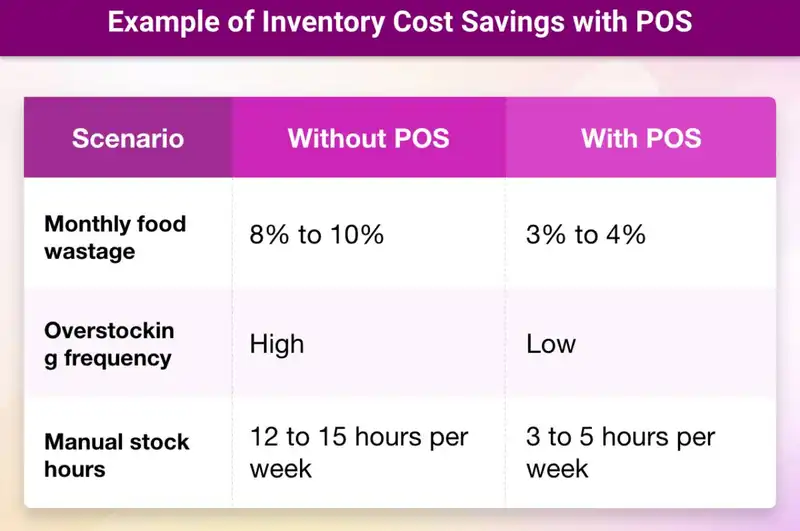
Example of Inventory Cost Savings with POS
These improvements directly contribute to restaurant technology cost savings by reducing wastage and improving purchasing decisions.
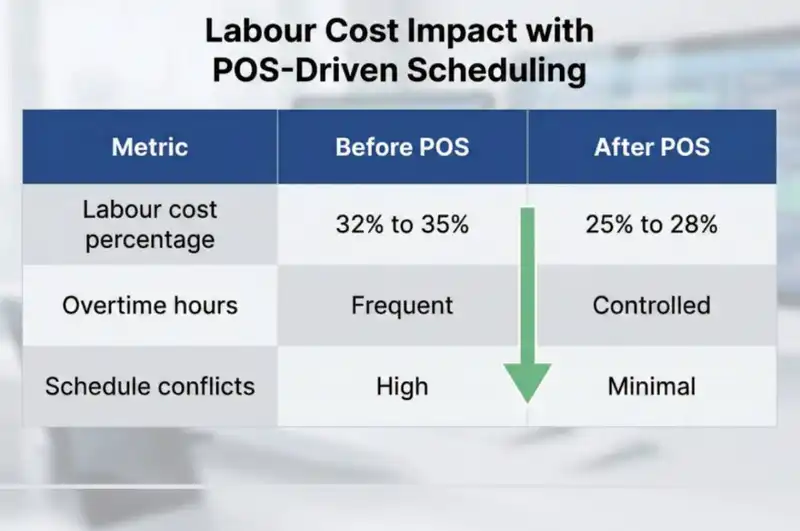
1. Reducing Labor Costs Through Smarter Staff Scheduling
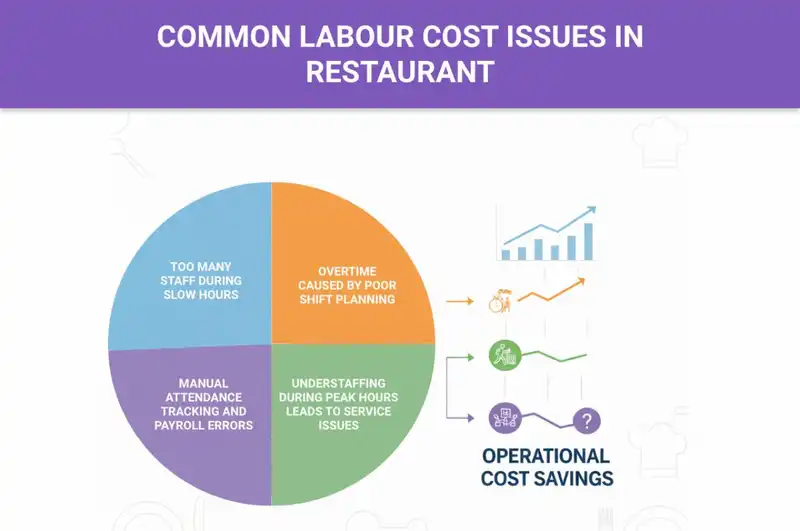
Labor is often the second biggest cost after food. Many restaurants overspend on staffing simply because schedules are not aligned with actual demand.
How a POS system controls Labor expenses
A POS system tracks sales volume, order count, and peak hours by day and time. This data helps managers schedule staff based on actual demand instead of guesswork.
POS based Labor management allows restaurants to-
- Match staffing levels with real customer traffic so that labor costs stay aligned with actual demand throughout the day. This ensures the right number of employees are scheduled without overstaffing or service gaps.
- Identify peak and non-peak hours accurately by analyzing sales and order volume data instead of relying on assumptions. This allows managers to plan shifts more effectively and improve service during busy periods.
- Prevent unauthorized overtime by setting clear limits and monitoring working hours in real time. This helps control payroll expenses and avoids unexpected labor cost overruns.
- Track employee attendance digitally to ensure accurate time records for every shift. This reduces payroll errors, minimizes disputes, and saves time spent on manual attendance management.
This is one of the most practical ways that helps reduce restaurant costs without affecting service quality.
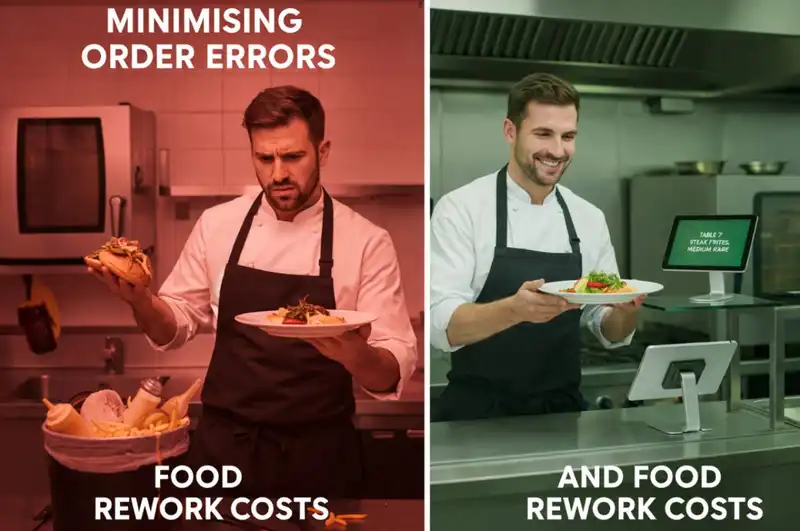
2. Minimising Order Errors and Food Rework Costs
Order errors create a chain reaction of losses. Food gets wasted, kitchen time increases, and customer satisfaction drops.
Why do order errors happen
Handwritten tickets may be hard to decipher and can be easily lost, resulting in erroneous or postponed orders. Misunderstandings or omissions frequently arise due to verbal communication gaps between the staff and the kitchen.
Neglected modifiers and specific instructions lead to wrong dishes and expensive remakes. Intense demand during busy times heightens the chances of errors as employees hurry to manage order quantities.
How POS systems improve order accuracy
Modern POS systems normalize the ordering procedure. Orders are sent straight from the server to the kitchen display system or printer with precise directions.
POS attributes that minimize order mistakes involve required modifiers for products that need selections, guaranteeing orders are finalized prior to arriving in the kitchen. Well-organized kitchen display layouts convey information in a simple-to-read manner, minimizing confusion during hectic service periods.
Special instruction tagging emphasizes allergies and customer preferences to ensure everything is accounted for. A training mode integrated within the system enables new employees to practice order-taking without impacting actual operations, aiding them in learning the system effectively and confidently.
Minimizing order mistakes leads to fewer reorders, less food waste, and improved table turnover. This directly aids in reducing costs for restaurant technology.
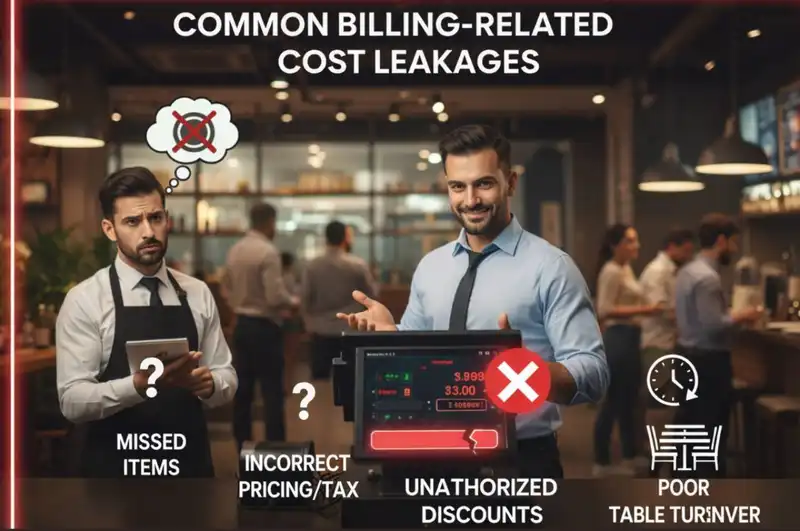
3. Preventing Billing Mistakes and Revenue Leakage
Billing errors often go unnoticed because they usually happen in small amounts, such as incorrect pricing, missed add-ons, or wrongly applied discounts. Individually, these mistakes may seem minor, but when they occur repeatedly across dozens or hundreds of transactions, they add up to significant revenue loss. Over time, unnoticed billing errors also create inconsistencies in reports, make it harder to track true profitability, and can lead to customer disputes or loss of trust if errors are discovered later.
How POS software improves billing control
A POS system automates pricing, tax, service charges, and discounts. Every order item is billed accurately, and all actions are logged.
POS billing benefits include faster and more accurate checkouts, which help reduce waiting time and improve the overall customer experience. Multiple payment options within one system make it easier for customers to pay using their preferred method.
Detailed reports on discounts and voids provide better visibility into billing activity and help identify irregularities. Reducing disputes at payment time improves customer trust and staff efficiency. Accurate billing ensures that restaurants collect the full value of every order, helping reduce revenue loss and control overall operating costs.
4. Saving Management Time Through Automation
Time spent on manual tasks is a hidden operational cost. Managers often spend hours preparing reports, reconciling cash, and coordinating staff.
Tasks automated by a POS system
Daily sales and shift reports provide a clear snapshot of performance for each business day, helping managers quickly review revenue and activity. Cash and payment reconciliation ensures that all transactions match collected payments, reducing discrepancies and errors. Inventory consumption tracking shows how stock is used throughout the day, helping control waste and plan reordering accurately.
Staff attendance summaries give managers a quick overview of working hours, making payroll processing and scheduling more efficient.
Automation allows managers to focus on improving service, training staff, and planning growth. This improves productivity and long-term POS software benefits.
5. Improving Decisions with Real Data Instead of Assumptions
Poor decisions cost money. Wrong menu pricing, ineffective promotions, or poor purchasing choices often come from a lack of data.
How POS data supports better decisions
Item-level sales reports help identify which dishes are most profitable and which ones generate low margins, allowing restaurants to refine pricing or recipes. Time-based reports reveal peak and slow hours, helping managers plan staffing and promotions more effectively. Category-wise analysis supports menu engineering by showing how different sections of the menu perform, making it easier to highlight high-performing items. Customer data enables targeted offers and personalized promotions, increasing repeat visits and overall revenue.
Data-driven decisions are one of the strongest restaurant technology cost savings advantages of POS systems.
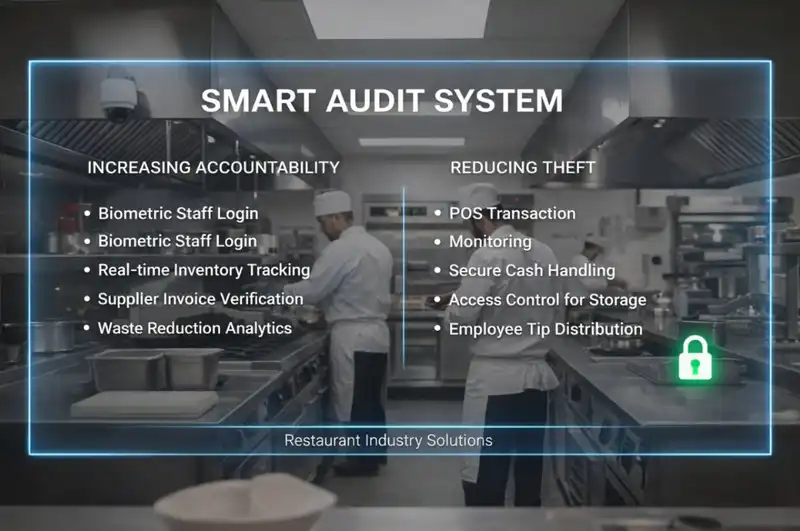
6. Increasing Accountability and Reducing Theft
Shrinkage and internal theft are sensitive but real issues that many businesses hesitate to address openly. Without proper visibility, small losses can accumulate over time and significantly impact profitability. Having clear systems in place helps identify problems early while maintaining trust and fairness within the team.
How POS systems increase accountability
Every transaction is tracked by the user, creating clear accountability for all sales and actions taken at the POS. Void and discount reports help highlight unusual patterns that may indicate errors or misuse. Cash drawer discrepancies become visible instantly, allowing issues to be addressed before they grow. Inventory variance reports identify missing or mismatched stock, helping uncover waste or shrinkage. This level of transparency improves discipline without micromanagement, enabling restaurants to protect margins and maintain operational control.
7. Supporting Growth Without Increasing Operational Complexity
Expansion frequently raises expenses when systems aren't structured to adapt to the company's growth. A POS system facilitates growth by standardizing menus and prices at all locations, guaranteeing uniformity without extra manual effort. It consolidates reporting, enabling owners to track performance from various sources in a single location, enhancing efficiency and oversight.
The system decreases the time needed to train new employees by offering familiar workflows and interfaces, ensuring uniform operations no matter the location. Consequently, restaurants can grow with assurance while still managing and lowering operational expenses for each location.
How Plum POS Supports Real Operational Cost Reduction
Plum POS is designed specifically for restaurant operations. It concentrates on streamlining everyday tasks while providing owners with complete insight into expenses.
Plum POS assists restaurants in monitoring inventory precisely by offering immediate insights into stock amounts and ingredient consumption. It streamlines workforce scheduling by matching employee shifts with real customer demand, aiding in the reduction of excess labor expenses.
The system minimizes order mistakes by standardizing entry processes and providing precise instructions straight to the kitchen. Moreover, Plum POS provides enhanced management of billing and discounts, guaranteeing consistent application of pricing rules. By utilizing clear reports, restaurant owners and managers can promptly assess performance and make knowledgeable operational choices.
Rather than introducing complications, Plum POS offers practical advantages of POS software that result in genuine savings.
Final Thoughts- Is a POS System Really About Cutting Costs?
Yes, but not in obvious ways. A POS system does not magically fix margins overnight. Instead, it works quietly in the background by stopping small daily leaks that often go unnoticed, such as minor billing errors, food waste, or inefficient staffing. It reduces friction in service by streamlining order flow, payments, and kitchen communication, allowing teams to work faster and with fewer mistakes.
Most importantly, it improves decision timing by giving managers access to real-time data rather than outdated reports. This encourages owners to ask the right questions every day- am I looking at today's numbers or last week's results, am I scheduling staff based on real data or old habits, and do I actually know where waste is happening in my operation?
In 2026, the restaurants that win are not the ones that have the system with the most features. They are the ones using simple systems consistently to reduce restaurant costs without hurting the guest experience.
The right POS works quietly in the background, while you focus on food, service, and growth.

Online Orders Made Easy
Plum POS Ensures Seamless Processing