Managing inventory is one of the most stressful parts of running a restaurant. One missing ingredient can disrupt service, frustrate customers, and hurt revenue. On the other hand, over-ordering leads to waste, spoilage, and unnecessary costs.
Most inventory problems are not caused by poor planning. They are caused by poor visibility.
That is exactly where POS-based inventory management makes a difference. When sales and inventory data work together, restaurants gain real control over stock, costs, and daily operations.
This blog gives you insights into the top benefits of POS systems in restaurant inventory management with real examples and clear explanations. You will also understand how to track restaurant inventory using a POS system in a practical, step-by-step way.
What is Inventory Management in a Restaurant Context?
Inventory management in a restaurant involves monitoring ingredients, supplies, and stock levels to guarantee efficient operations. It includes understanding what is in stock, what is currently in use, and what requires reordering.
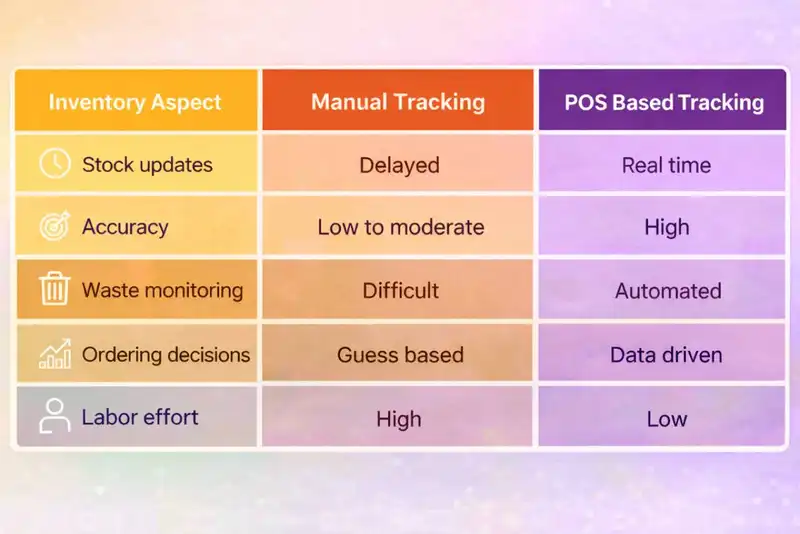
In the absence of adequate systems, eateries frequently depend on manual tallies, spreadsheets, or recall. These techniques function for a limited time but falter as the volume of orders grows.
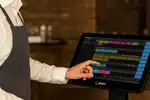
When inventory integrates with a restaurant POS system, each sale instantly refreshes stock quantities. This link removes uncertainty and delivers precise, instant information.

Accept, Process, and Profit with Ease!
Streamline Your Online Orders with Plum POS
Why Do Restaurants Struggle with Inventory Without a POS?
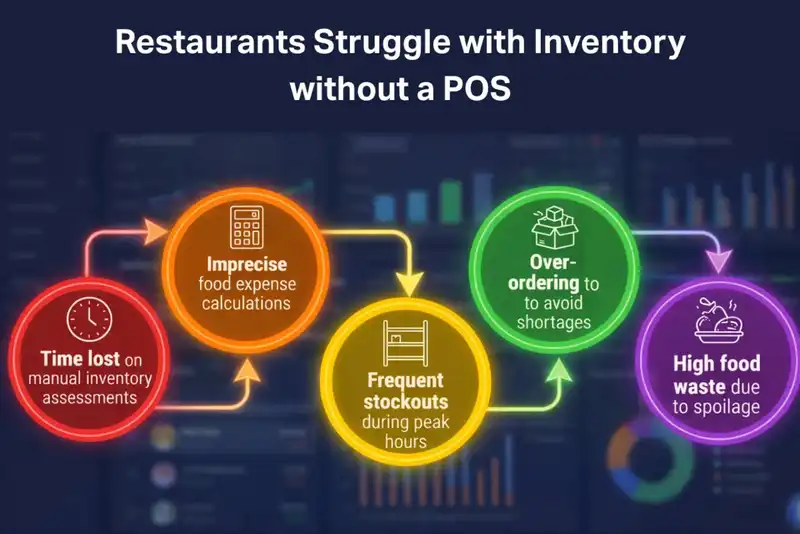
Before looking at the benefits, it is important to understand the common problems restaurants face without POS-driven inventory tracking. Most restaurants without POS inventory integration experience-
- Frequent stockouts during peak hours- When inventory isn't automatically updated with sales, popular items may unexpectedly deplete. In peak service times, this results in missing menu items, slower service, and irritated customers.
- Over-ordering to avoid shortages- To counteract uncertainty, managers frequently acquire excessive inventory. Though this lowers the chance of depleting stock, it raises storage expenses and immobilizes funds in surplus inventory
- High food waste due to spoilage- Without precise monitoring of usage and expiration dates, perishable items are at a higher risk of spoiling before they are utilized. This has a direct impact on profit margins.
- Imprecise food expense calculations- When inventory information is not accurate, determining real food costs becomes challenging. Restaurants might inadvertently undervalue menu offerings or overlook diminishing profit margins.
- Time lost on manual inventory assessments- Employees are required to invest hours tallying inventory manually, reconciling data sheets, and probing into inconsistencies. This detracts from the quality of service and the overall customer experience.
Furthermore, the absence of centralized reporting complicates the detection of theft, discrepancies in portions, or changes in supplier pricing. Decision-making shifts to being reactive rather than based on data. Consequently, extending to various locations or broadening the menu poses risks due to the lack of a dependable system for managing costs.
How Does a POS System Help Track Restaurant Inventory?
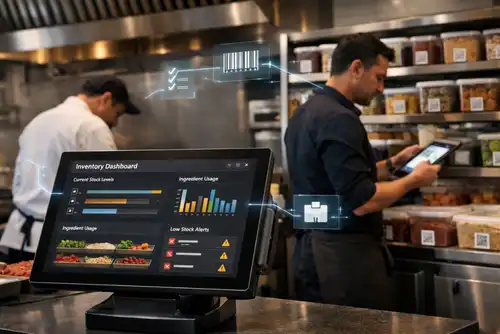
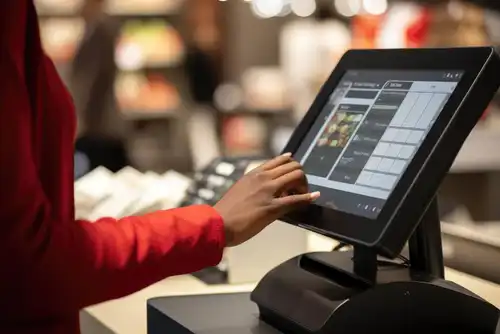
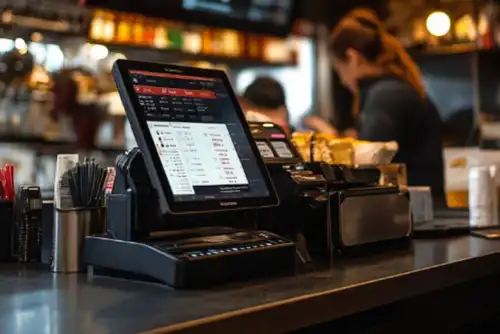
Understanding how to track restaurant inventory using a POS system starts with understanding the data flow. In a contemporary dining establishment, your POS serves more than merely as a billing device. It functions as a primary control hub that links your menu items to inventory at the ingredient level, powered by restaurant POS system features that track inventory in real time.
Whenever a transaction occurs, the system automatically refreshes your inventory according to set recipe mappings.

From Click to Kitchen
Handle All Your Online Orders with Plum POS
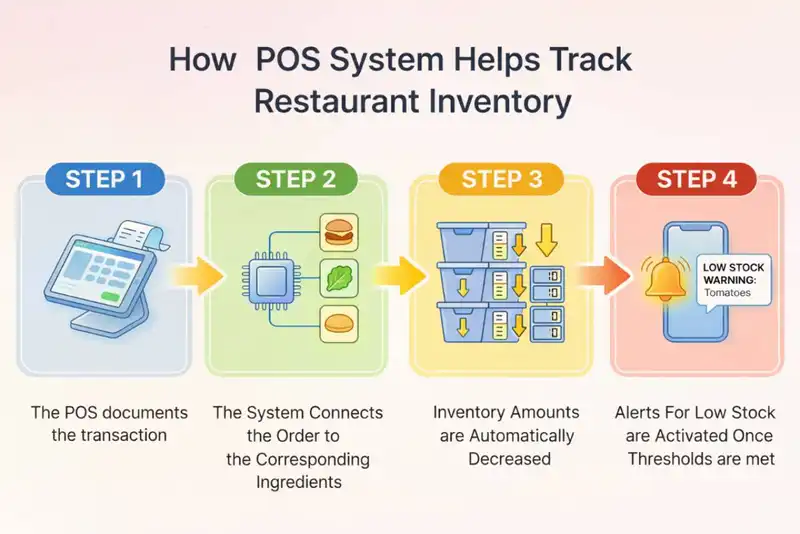
Here's how the process works step by step-
1. The POS documents the transaction.
Once the order is placed, the POS records the transaction. This encompasses item specifics, amount, adjustments, and sale timestamp. The information is saved immediately in the system.
2. The System Connects the Order to the Corresponding Ingredients.
Every menu item is pre-assigned to a recipe within the POS. For instance, if a burger has a bun, patty, cheese slice, and lettuce, the system recognizes the precise amount of every ingredient needed for a single serving.
3. Inventory Amounts are Automatically Decreased.
After the order is verified, the POS subtracts the precise ingredient amounts from stock. When three burgers are sold, the inventory of buns, patties, cheese, and lettuce reduces correspondingly. This occurs immediately and without any manual intervention.
4. Alerts For Low Stock are Activated Once Thresholds are met.
Restaurants may establish minimum inventory thresholds for essential ingredients. When the quantity of any of these ingredients drops below the set limits, the system produces alerts. This enables managers to reorder in advance rather than responding to shortages.
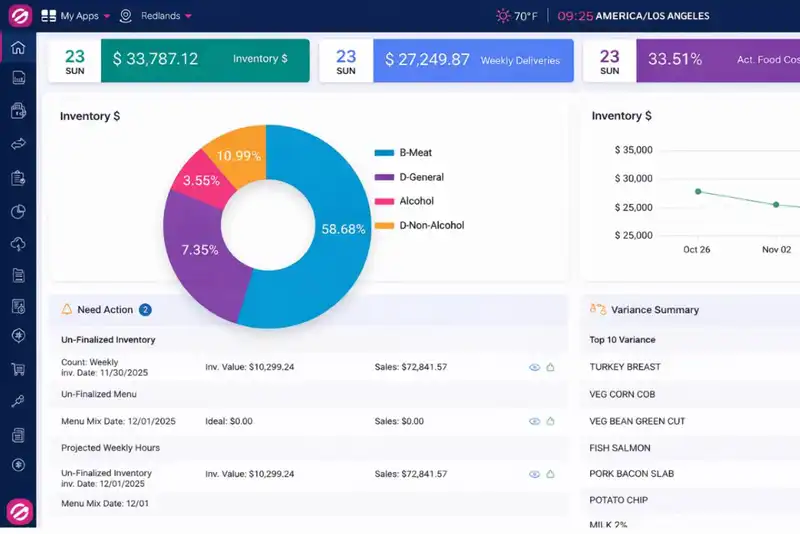
This ongoing data cycle ensures inventory matches real sales activity. Since deductions are automated, there is significantly reduced potential for human error. Managers can view up-to-the-minute reports detailing available inventory, daily usage patterns, variance analyses, and reorder recommendations.
How Does Real-Time Inventory Tracking Improve Daily Operations?
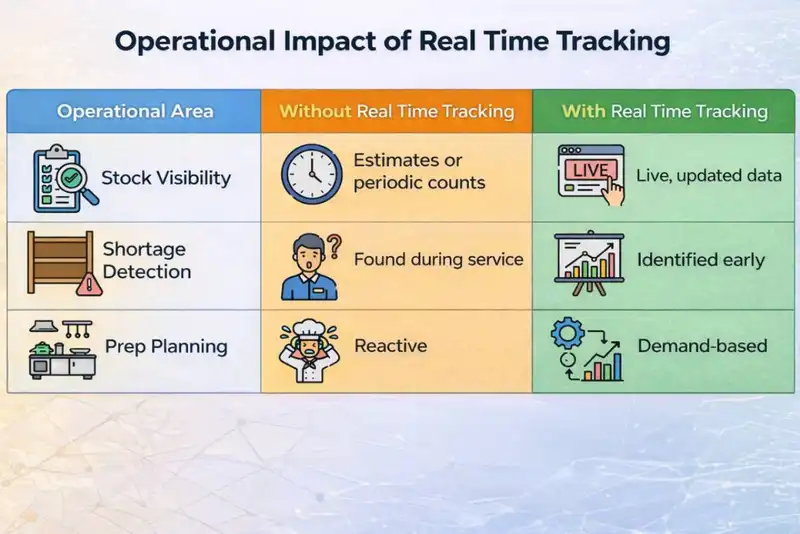
Real-time inventory tracking is one of the most powerful benefits of using a POS system in restaurant operations. Instead of relying on manual counts or end-of-day updates, managers can view live stock levels as sales happen. This provides accurate, up-to-date information throughout the day.
With real-time visibility, managers can monitor fast-moving ingredients, spot slow-moving stock, and adjust prep quantities based on actual demand. This helps prevent over-prepping and reduces food waste.
The difference is clear-
Instead of discovering shortages during peak hours, restaurants using a POS system for inventory management can act early and maintain smoother operations, better cost control, and improved customer satisfaction
How Does POS Based Inventory Management Reduce Food Waste?
Food waste is one of the biggest hidden profit drains in restaurants. POS based inventory management minimizes this by connecting each sale to its corresponding recipe, guaranteeing that inventory reductions align with actual usage. This stops excessive preparation and minimizes uncertainty.
The system also points out frequently used and rarely used ingredients, aiding managers in modifying portions or developing specials before inventory runs out. Numerous POS systems monitor purchase dates and expiration periods, aiding in improved stock management.
By standardizing serving sizes and enhancing transparency regarding ingredient utilization, restaurants can greatly minimize waste. Most companies experience noticeable enhancements within weeks of adopting POS-based inventory management.
How Does POS Inventory Tracking Improve Ordering Accuracy?
Ordering inventory without trustworthy data frequently leads to excess stock or unforeseen deficits. When choices rely on gut feelings rather than real sales trends, restaurants either lock up funds in surplus stock or face the danger of depleting essential items during busy times.
POS inventory monitoring enhances order precision by utilizing actual sales information to inform buying choices. Reorders rely on consumption patterns instead of assumptions, enabling managers to adjust stock levels according to real demand. Sales reports from the past simplify the forecasting of seasonal variations, weekend increases, and the effects of promotions.
Due to the system's continuous monitoring of ingredient usage, supplier orders are more reliable and accurate. This minimizes urgent last-minute buys and enhances vendor partnerships.
Acquiring skills in monitoring restaurant inventory through a POS system equips eateries with a systematic, data-oriented method for ordering, removing uncertainty with quantifiable insights, and enhancing overall cost management.
How Does POS Inventory Management Prevent Stockouts?
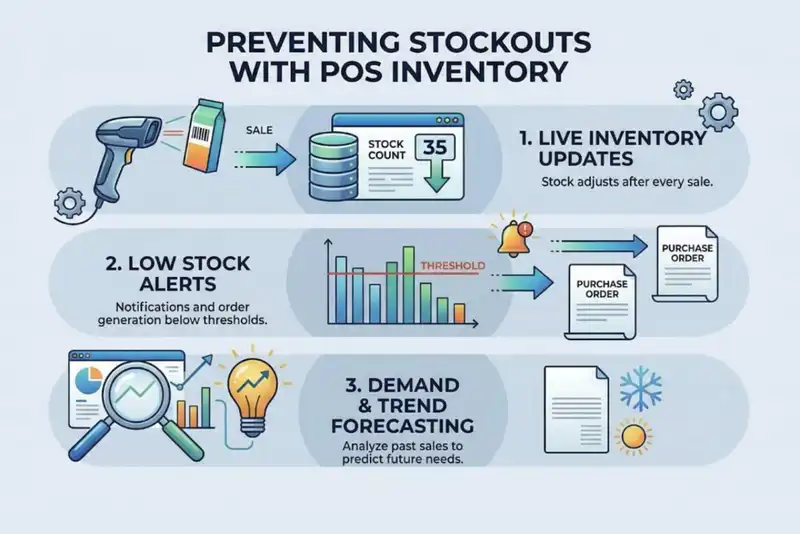
POS inventory management helps in avoiding stockouts by providing companies with immediate insight into their inventory status. Each time a product is purchased, the inventory count is automatically updated by the POS system. This removes the requirement for manual monitoring and guarantees that companies consistently have a precise understanding of their available inventory.
For example-
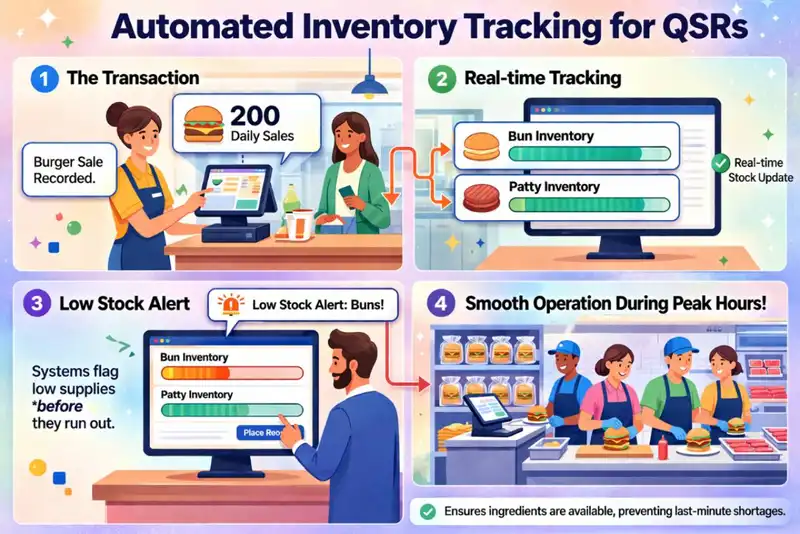
A Quick-service Restaurant selling 200 burgers daily can automatically track bun and patty consumption through the POS system. Each burger sale reduces ingredient stock in real time, helping managers see when supplies are running low and reorder before shortages occur. This prevents last-minute ingredient shortages during peak hours.
An additional important aspect is notifications for low stock and reorder thresholds. Companies can establish minimum inventory levels for each item, and when stock amounts fall below this threshold, the POS system generates automatic alerts. Certain systems can also create purchase orders or reorder requests for suppliers, enabling companies to replenish items before they deplete.
POS systems additionally evaluate sales patterns and customer needs by utilizing historical data. By recognizing trending products and seasonal purchasing trends, companies can predict demand more precisely and uphold ideal inventory levels. This data-oriented method guarantees that popular products are consistently in stock, minimizing stockout risks and enhancing customer satisfaction.
How Does POS Based Inventory Tracking Support Cost Control?
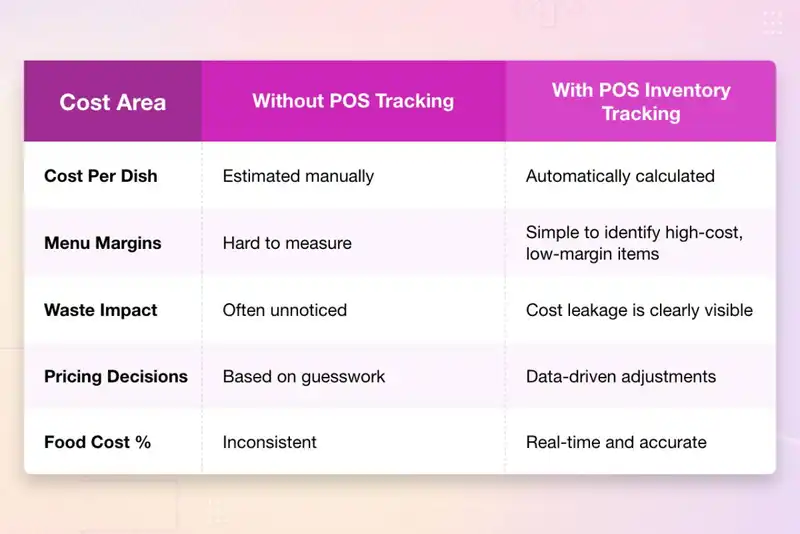
Inventory is closely linked to food expenses, and without precise monitoring, food cost ratios can swiftly become untrustworthy. POS inventory monitoring enhances expense management by automatically determining the ingredient cost per dish according to defined recipes and acquisition prices.
It also aids in spotting high-cost, low-margin menu items that might need price changes or portion modifications. Moreover, the system uncovers cost losses due to waste, excessive portion sizes, or spoilage. Improved cost transparency allows restaurants to make wiser pricing choices, enhance financial planning, and boost overall profitability.
How Does POS Inventory Integration Improve Staff Efficiency?
Manual inventory activities take up precious time and frequently distract staff from essential service duties. POS systems lighten this burden by automatically subtracting inventory as sales happen, removing the necessity for manual updates.
They additionally decrease the occurrence of complete physical counts and streamline daily inventory assessments via real-time reporting. By reducing human mistakes and optimizing processes, POS systems enhance operational efficiency, facilitating smoother daily workflows for restaurant staff.
Menu choices should rely on quantifiable outcomes instead of beliefs. POS inventory data offers valuable insights into the best-selling items, the ingredients that drive up costs, and menu items that lead to excessive waste.
It also emphasizes the meals that provide greater profit margins. This level of visibility allows restaurants to create menu designs that more effectively manage customer demand, control costs, and enhance overall profitability.
How Does POS Inventory Management Scale with Business Growth?
As restaurants grow, overseeing inventory becomes increasingly complicated due to various locations, differing demand trends, and larger purchase quantities. A POS system supports this growth by consolidating inventory information from across different locations, enabling management to uphold transparency and control. It aids in standardizing recipes and portion sizes, guaranteeing uniformity in cost and quality.
The system monitors location-based consumption patterns and ensures consistent ordering procedures. This scalability gives POS-driven inventory management a prime benefit of POS systems in a restaurant's growth plan.
How Does POS Inventory Management Improve Financial Reporting?
Inventory information is essential for precise financial reporting. POS systems enhance this process by linking inventory utilization directly with sales information, guaranteeing that food cost assessments represent true performance.
They enhance cost accuracy, facilitate in-depth profit assessment at a granular level, and streamline audits and financial evaluations. By having clearer, more dependable data, restaurants can make wiser operational and financial choices.
What Are the Risks of Not Using POS Inventory Management?
Restaurants that avoid POS-based inventory management frequently face increasing food expenses caused by improper stock oversight and overlooked waste. Frequent service disruptions can occur when essential ingredients are unexpectedly depleted, resulting in inconsistent menu options and dissatisfied customers.
In the absence of system-based tracking, maintaining staff accountability becomes more challenging, and recognizing errors proves to be tougher. With business growth, these inefficiencies accumulate, making it difficult to scale operations effectively. Neglecting inventory technology over time greatly elevates both operational and financial risks.
Important Tip for Successful POS Inventory Tracking
Technology achieves optimal outcomes when backed by well-defined processes. Restaurants need to verify that recipes are accurately documented, employees adhere to portion control guidelines, and inventory reports are consistently examined. Regular physical audits are essential to confirm system precision.
Why Are POS Systems Becoming Essential for Inventory Management?
The restaurant industry is becoming more data-driven. Customers expect consistency, availability, and quality. POS systems make this possible by turning inventory management into a structured process instead of a daily struggle.
That is why understanding how to track restaurant inventory using a POS system is no longer optional for modern restaurants.
Final Thoughts on POS Systems and Inventory Management
Inventory problems rarely come from a lack of effort. They come from a lack of visibility and reliable data.
Connecting sales directly to inventory movement, POS-driven inventory management provides restaurants with enhanced oversight of daily operations and long-term planning. It aids in minimizing food waste by effectively monitoring ingredient consumption and stopping excess production.
Simultaneously, it reduces stockouts by offering real-time insights into inventory levels. Accurate cost information allows restaurants to enhance cost management and make more informed pricing and menu development choices. This organized, data-focused method also facilitates scaling operations with assurance and uniformity.
The long-term benefits of POS systems in restaurant inventory workflows go far beyond convenience. They protect margins, improve service quality, and create operational stability.
For restaurants serious about efficiency and growth, POS driven inventory management is not just a tool. It is a foundation.

Online Orders Made Easy
Plum POS Ensures Seamless Processing