The fast food sector has consistently been characterized by a fundamental commitment- provide food rapidly, reliably, and in large quantities. For many years, that assurance was realized via standardized methods, skilled personnel, and closely regulated functions. However, that model is facing growing scrutiny today.
Labor shortages persist in interrupting daily operations, as numerous restaurants face challenges in hiring and keeping employees. Increasing wages are constricting already narrow margins. Customers now demand more than ever speedy service, precise orders, digital ease, and tailored experiences. The discrepancy between customer expectations and the capabilities of conventional systems is increasing.
This is where automation in fast food comes into play, not as a vision of the future, but as a tangible solution to actual operational issues. Automation has evolved beyond standalone tools such as POS systems or online ordering platforms. It is evolving into a completely unified method that transforms the operations of fast food companies from start to finish.
Understanding the Shift Toward Fast Food Automation
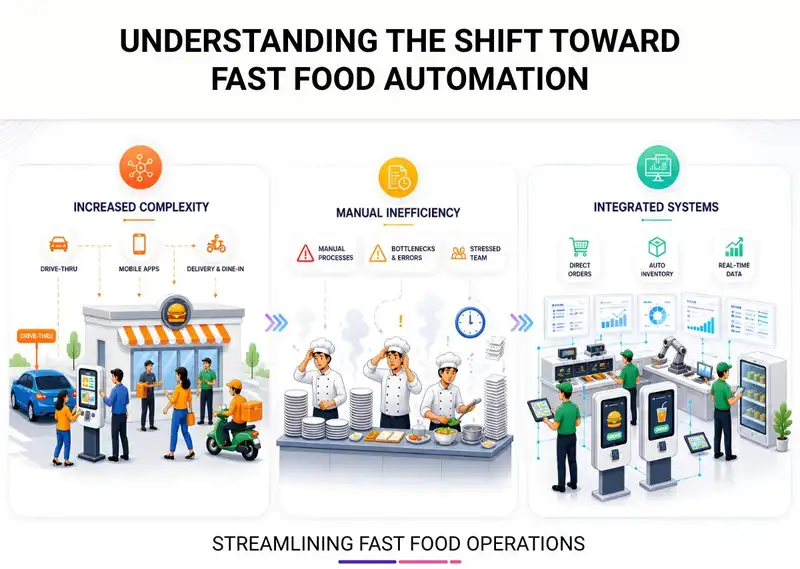
Recognizing how significantly the fast food landscape has evolved in the past 10 years is crucial to comprehending the increase in automation. Restaurants are no longer catering exclusively to walk-in patrons. They are concurrently handling mobile orders, third-party delivery services, drive-thru customers, and dine-in customers. Every one of these channels introduces additional complexity to operations.
Managing this complexity by hand is ineffective and frequently unsustainable. Orders may be postponed or mishandled, kitchens can get overloaded, and employees might find it difficult to manage during busy times. Automation tackles this issue by establishing organized, reliable processes that minimize dependence on manual management.
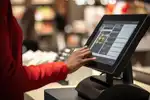
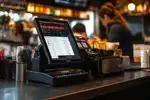
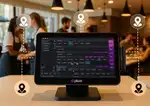
At its essence, fast food automation focuses on substituting disjointed processes with integrated systems. Orders made via kiosks or mobile applications are sent straight to kitchen display systems. Stock levels refresh automatically as products are purchased. Information is gathered instantly, enabling managers to make quicker and better-informed choices. Restaurants can foresee issues rather than simply responding to them.

Simplicity at its Best
Maximize Your Sales with Plum POS
The Forces Driving Fast Food Automation
The adoption of automation results from multiple factors, not just one, but rather a mix of structural changes in the industry.
The constant problem surrounding worker supply, many industry experts agree, is one of the greatest issues today for quick-service restaurants. Due to its relatively simple tasks (order-taking, cooking food, etc.), the fast-food industry has traditionally relied on large staffs to provide a manageable volume of customers with their needs. Current high turnover rates in the workforce and changing employee expectations have created a great deal of uncertainty for businesses trying to fill positions. Employees are looking for increased wages, better working conditions, or completely new careers, meaning restaurants continue to struggle with staffing shortages.
In addition to confusion due to employee shortages, rising labor costs are causing a great deal of complexity in the industry. As labor costs increase, the cost of maintaining large teams increases, leading to decreased overall restaurant profitability. Automation is one potential solution to reducing LRA's dependence on human labor while ensuring high-quality service to customers. Automation will not eliminate the need for employees in the workforce; rather, it will facilitate the redefining of an employee's role within the company, creating a new emphasis on those jobs that require human experience and judgment.
Another element of the workforce challenge will be the increasing complexity of consumer needs and expectations. Today's consumers expect personalization, speed, and ease of use all at once. For example, a single customer order might have three different modifications, four different dietary needs, and five different additional items. Manually recording and processing customer orders at this level only increases the likelihood of making mistakes. By automatically recording and processing each order, there will be fewer opportunities for errors to occur.
Another aspect of this dynamic is that the quick acceptance of digital ordering technology has begun to change consumer behaviour. The use of mobile apps, web-based ordering systems, and delivery services represents new revenue streams for restaurants.
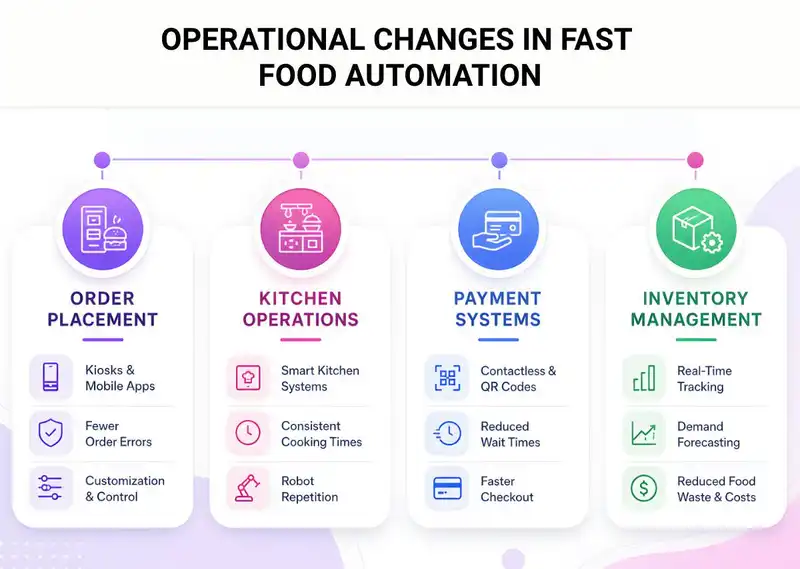
How Automation in Fast Food Is Changing Operations
The effects of automation are evident in all areas of a fast food restaurant, starting from when a customer orders to the ultimate delivery of their meal.
A noticeable change is in the way orders are placed. Self-service kiosks and mobile applications enable customers to submit their own orders, removing the requirement for staff to enter data manually. This not only minimizes mistakes but also provides customers greater control over their selections. They have the flexibility to savor their time, tailor their meals, and examine menu choices without any pressure. For restaurants, this results in improved order precision and frequently larger average check amounts.
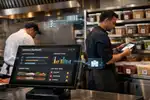
In the kitchen, automation is transforming the way food is made. Intelligent kitchen systems manage orders, rank tasks, and guarantee that every item is made at the appropriate moment. Automated devices like fryers and grills can uphold exact temperatures and cooking times, minimizing variability and enhancing consistency. In certain instances, robots are being implemented to manage repetitive tasks such as flipping burgers or assembling components, enabling human workers to concentrate on quality assurance and supervision.
Payment systems have advanced considerably as well. Contactless payments, QR codes, and digital wallets have simplified the checkout experience, cutting down wait times and lowering physical contact. This change enhances customer convenience while also boosting table turnover and improving operational efficiency.
In the background, inventory management has advanced in complexity due to automation. Systems can monitor inventory levels in real time, forecast demand using past data, and send notifications when stock is low. This minimizes the chances of having excess inventory or depleting essential ingredients, which ultimately decreases food waste and enhances cost management.

Let’s Start Digitalizing Your Signage Today!
Plum Digital Signage Simple & Clean
Trends in Fast Food Automation Shaping the Future
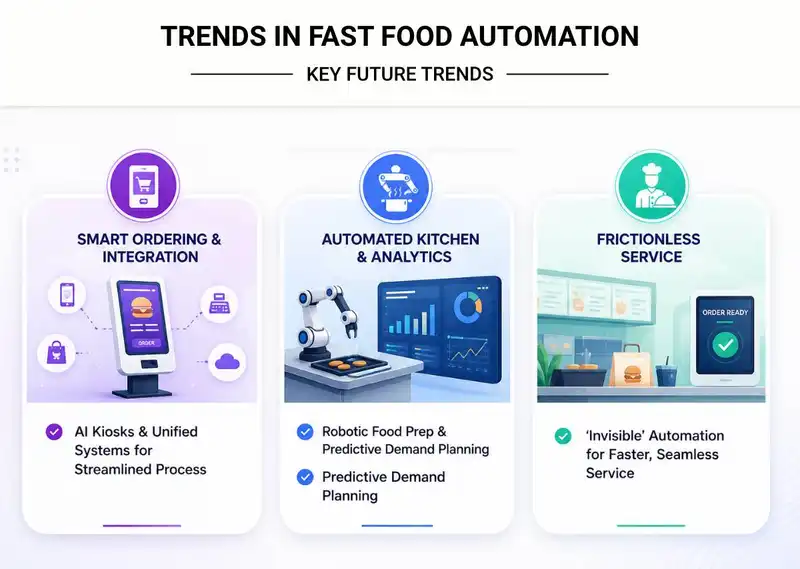
With the ongoing evolution of automation, numerous Fast Food Automation Trends are significantly influencing the industry's future.
Artificial intelligence is becoming more and more essential to operations. Systems for ordering powered by AI can interpret voice commands, handle intricate orders, and even propose extra items based on customer preferences. This not only boosts precision but also elevates the entire customer experience by rendering interactions more intuitive.
Integration stands out as another key trend. Restaurants are shifting from using individual tools for ordering, kitchen management, inventory, and payments to integrated systems that allow all parts to function collaboratively. This degree of integration facilitates a smooth exchange of information, minimizing delays and enhancing coordination.
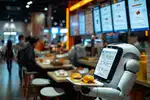
Robotics is increasingly becoming popular, especially for tasks that are repetitive and require significant labor. Although completely automated kitchens remain uncommon, the strategic implementation of robotics can greatly enhance efficiency and uniformity. For instance, robotic fry stations can function nonstop without exhaustion, sustaining the same performance level all day long.
Predictive analytics is changing how decisions are made. Through the examination of past data and current trends, restaurants can predict demand, enhance staffing, and proactively modify inventory levels. This transition from reactive to predictive operations enables companies to function more effectively and prevent expensive interruptions.
One of the most intriguing trends is the shift towards what may be termed invisible automation. As systems evolve, they function behind the scenes without being apparent to users. The emphasis moves from the technology to the experience it facilitates- quicker service, more seamless interactions, and increased convenience.
Case Study - Automation in Fast Food at White Castle
With labor shortages and a rising demand for efficiency, fast food chains are increasingly looking to automation to address these challenges. White Castle, the well-known fast food chain famous for its sliders, has led this trend by collaborating with Miso Robotics to implement automated kitchen technology in their eateries.
One of the major obstacles that White Castle encountered was the workforce shortage that impacted numerous fast-food restaurants. Due to a reduced number of employees, the restaurant needed to discover a method to uphold its exceptional service and food standards. The answer was to automate specific elements of their kitchen, beginning with the frying station.
White Castle collaborated with Miso Robotics to create an automated fryer called "Flippy." Flippy is an AI-powered robotic arm that oversees the cooking process to guarantee that every batch of fries is perfectly cooked. The technology enables more efficient cooking since Flippy can prepare several batches at once, minimizing customer wait times.
The incorporation of Flippy into the kitchen at White Castle has proven to be a tremendous success. The automated fry station has enabled quicker service and enhanced order precision, resulting in higher customer satisfaction. The successful pilot program has resulted in plans for increased automation, featuring Flippy in additional kitchen stations and incorporating other automated systems like order-taking kiosks.
Nonetheless, the advent of automation in fast food has faced its share of difficulties. Although the technology has enhanced efficiency and customer satisfaction, it has also generated worries regarding job loss. White Castle has responded to these issues by retraining staff to operate alongside the new technology and offering them fresh advancement opportunities within the organization.
Real-World Applications of Fast Food Automation
To fully understand the impact of fast food automation, it helps to look at how leading brands are already applying it in real-world scenarios.
Leading fast-food chains are no longer testing; they are now progressively implementing automation across their outlets. Self-order kiosks have become commonplace in numerous global brands, enabling restaurants to manage large customer volumes without raising front-of-house staff levels. These kiosks enhance order precision while also subtly encouraging increased spending by offering upselling suggestions.
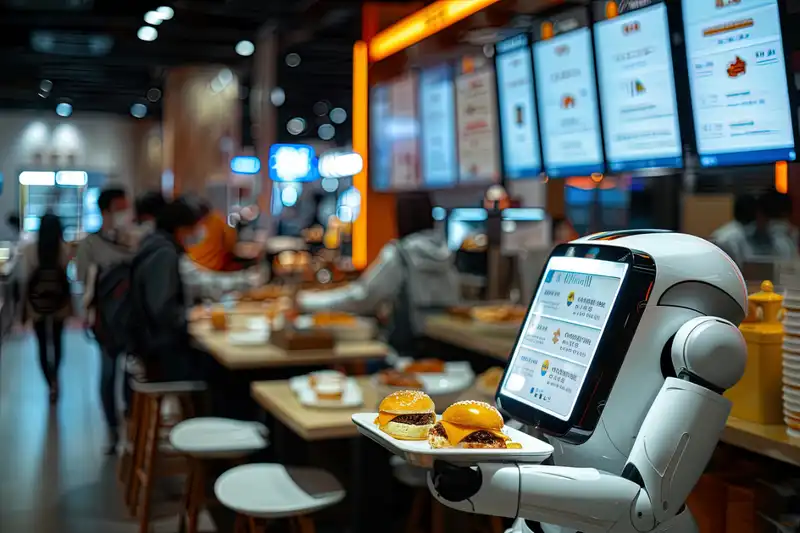
In the kitchen, robotics is being implemented strategically instead of replacing complete workflows. For instance, robotic systems are employed in repetitive, high-volume activities such as frying or flipping burgers. This guarantees uniform results while alleviating stress on employees during busy times.
Delivery is another field experiencing swift advancements. Certain brands are experimenting with self-driving delivery vehicles and robots to lessen dependence on human drivers. Although still developing, this indicates a transition towards entirely automated order fulfillment systems.
Even drink franchises are utilizing automation via mobile-centric ordering platforms, allowing customers to place orders ahead of time and just collect them, completely removing lines.
These practical applications demonstrate that automation is not just a concept; it is actively transforming everyday tasks.
Challenges and Considerations
Even with its benefits, implementing automation comes with difficulties. The upfront investment can be considerable, especially for smaller operators. Sophisticated systems, robotics, and integration platforms need investment, which might not be easily accessible for every company.
The process of integration can be intricate. Achieving smooth collaboration among various systems necessitates meticulous planning and implementation. Ineffective implementation of automation can lead to new inefficiencies instead of solving the current ones.
The human element must also be taken into account. Workers must be educated to collaborate with automated systems, and opposition to change can hinder adoption. Effective execution demands not only technological advancements but also a change in the organization's culture.
Ultimately, dependence on technology brings forth additional risks. Without backup processes, system failures, connectivity problems, or software errors can interrupt operations.
What the Future Holds for Fast Food Automation
Fast-food automation is changing how quick-service restaurants operate, allowing for improved speed, accuracy, and convenience, both for the staff working there and their customers. While there are some challenges to automating fast-food operations, the benefits far outweigh those challenges once again.
With ongoing advancements made in robotics and artificial intelligence, there will be limitless opportunities available to automate many aspects of the fast-food type of food service.
Technology continues to become more prevalent; companies in any industry need to begin incorporating the new technology if they are going to remain competitive among their peers. The fast-food industry is evolving just like every other industry, so we must make sure that job losses do not happen, and we provide an avenue for people to have success in this new economy.
As automation continues to be integrated into the fast-food industry, it will be essential that we also continue to focus on providing consistent levels of quality and safety for the preparation of popular menu items such as French fries.
Conclusion
The increase in automation in the fast food sector signifies a significant change in the way the industry functions. Confronted with labor shortages, increasing expenses, and changing customer demands, restaurants are embracing automation as a viable and strategic approach.
This change extends past just efficiency. The focus is on developing systems that are quicker, more intelligent, and more dependable, while also enhancing the experience for clients.
As trends in fast food automation progress, the successful businesses will be those that implement automation strategically, not only to lower expenses but to create more robust and flexible operations.
Ultimately, automation is not taking the place of the fast food industry. It is reshaping it for what lies ahead.

Reduce Your Labor Cost Now
Simplify Employee Time and Attendance with Plum Clock
















-Benefits-&-POS-Guide-150-90faf61de.webp)