Somewhere between the second location opening and a processing statement that doesn't quite add up, most restaurant owners start Googling "Square alternatives." The reasons are rarely dramatic processing costs that stop making sense at higher volume, hardware that feels locked in, inventory that gets sloppy once there's more than one site to track, and reporting that doesn't actually tell the restaurant story. Square earns its place for new counter-service spots and food trucks that need a flat rate and a fast setup, but it wasn't built to grow at the same pace some restaurants do.
This blog isn't a takedown of Square; plenty of operators genuinely don't need to leave it. It's a practical rundown of the alternatives that show up most often on serious shortlists in 2026- Plum POS, Toast, Clover, Lightspeed Restaurant, TouchBistro, Revel Systems, and SpotOn Restaurant. For each one, we'll cover what it's good at, where it struggles, and which type of restaurant it fits best, along with a comparison table and a section on how to actually make the call.
Best Alternatives to Square POS in 2026
If you want the quick answer before the long one- the alternatives that come up most often in serious operator conversations right now are Plum POS, Toast, Clover, Lightspeed Restaurant, TouchBistro, Revel Systems, and SpotOn Restaurant.
- Plum POS leans into operational depth, inventory down to the recipe level, labor cost tracking, and centralized reporting for operators running more than one site.
- Toast has the biggest restaurant-native ecosystem and integration library, especially popular with growing full-service and multi-unit brands.
- Clover trades some restaurant-specific depth for hardware and processor flexibility.
- Lightspeed Restaurant is a strong pick for full-service, wine-heavy, hospitality-forward concepts.
- TouchBistro suits independent full-service restaurants that want restaurant tools without enterprise complexity.
- Revel Systems is built for scale franchises and high-volume multi-location groups.
- SpotOn Restaurant bundles POS with built-in marketing tools, popular with independents.

Accept, Process, and Profit with Ease!
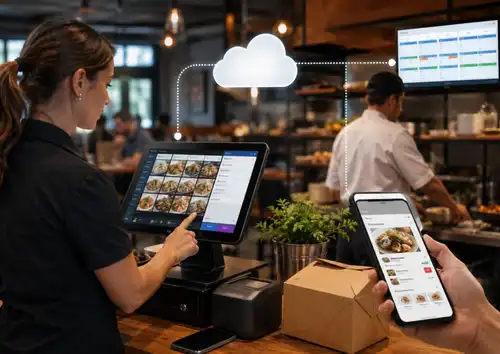
Streamline Your Online Orders with Plum POS
Comparison Table
Pricing across this whole category shifts often, and most of these companies quote based on your specific volume, terminal count, and add-on modules rather than publishing a single flat number. Treat the table as directional and confirm current rates directly with each provider before you sign anything.
The Detailed Rundown of Top Square Alternatives
Below are the detailed insights into the top Square POS alternatives, including their key strengths, limitations, and ideal restaurant types.
Plum POS
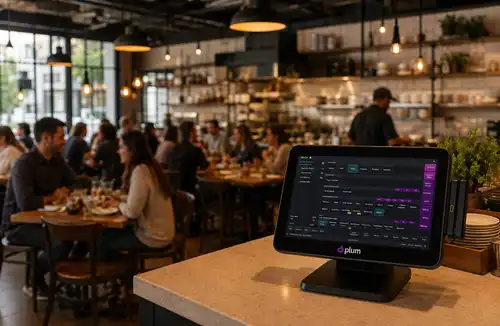
Plum POS is a cloud-based restaurant POS platform, and the way to think about it is less "payment terminal with restaurant features bolted on" and more "operations platform that happens to process payments." The feature set is weighted toward the parts of running a restaurant that actually eat an owner's time- labor scheduling, recipe-level food cost tracking, and reporting that pulls multiple locations into one view instead of forcing you to check each site separately.
It can track inventory down to ingredient and recipe level, automatically deduct stock after every sale, monitor food cost variance, and reduce waste across locations, the kind of thing a lot of general-purpose systems only get to with paid add-ons. Reporting built around restaurant-specific math also saves the step of exporting everything into a spreadsheet just to calculate prime cost by hand, which is a small thing until you're doing it every single week.
Best For- Full-service restaurants and growing multi-location groups actively managing food and labor cost as core levers in the business, not just line items on a report.
Key Strengths-
- Recipe-level inventory tracking with automatic stock deduction after every sale
- Food cost variance monitoring and waste tracking across locations
- Centralized, multi-location reporting and menu control
- Native labor scheduling and labor cost tracking
Limitations-- Custom-quote pricing means no published rate card to compare at a glance
- More operational depth than a single-location, low-complexity business typically needs
Ideal Restaurant Type- Full-service, growing multi-unit groups

From Click to Kitchen
Handle All Your Online Orders with Plum POS
Toast POS
Toast is arguably the most widely recognized restaurant-native POS on the market, and for good reason it was built for food service from the start rather than adapted from a general retail platform. The order management, kitchen display integration, and table management all feel purpose-built, and the third-party integration marketplace is large enough that most operators can find a payroll, accounting, or delivery connection that already exists rather than needing something custom.
Best For- Full-service and growing multi-unit brands that want a mature, deeply restaurant-specific ecosystem.
Key Strengths-
- Native kitchen display system and table management
- Large integration marketplace (accounting, payroll, loyalty, delivery)
- Offline mode keeps orders, card payments, and KDS running during outages
Limitations-- Core system runs on Toast-branded hardware, so switching usually means new terminals across the board
- Bundled subscription-and-processing pricing can feel less transparent up front
- Onboarding can take longer than a simpler self-serve platform
Ideal Restaurant Type- Full-service, QSR, growing multi-unit brands
Clover
Clover, backed by Fiserv, takes a different approach entirely. Instead of building one deep restaurant-native system, it offers an app marketplace on top of flexible hardware and a wide network of processors. That flexibility is the whole pitch- you're not locked into one processor's rates, and you can add functionality loyalty, online ordering, inventory as you actually need it rather than paying for a full restaurant suite from day one.
Best For- Operators who want to shop around on processing rates and build their feature set incrementally.
Key Strengths-
- Wide processor and hardware flexibility
- Large app marketplace covering accounting, payroll, and loyalty
- Clover AI adds predictive inventory insights and fraud detection
- 90-day free trial available on select plans
Limitations-- Restaurant-specific workflows like course firing often live in add-on apps rather than the core system
- Sold through many resellers, so pricing and feature availability can vary
- Hardware is locked to Clover if you buy direct
Ideal Restaurant Type- QSRs, cafes, smaller full-service restaurants
Lightspeed Restaurant
Lightspeed leans hospitality, thinking full-service dining rooms with real wine programs, detailed beverage inventory, and floor plans that matter to the guest experience. The table and course management is strong, and the inventory and reporting tools go deep enough to handle a serious beverage program and ingredient-level cost tracking, which is where a lot of general POS systems start to feel thin.
Best For- Fine dining, upscale casual, and hospitality-forward concepts with detailed wine or beverage programs.
Key Strengths-
- Deep reporting and analytics, including ingredient-level cost and menu profitability tracking
- Strong table and course management for full-service floors
- Wide range of accounting and reservation integrations
Limitations-- Built-in offline mode requires an added hardware device, and card processing still needs connectivity
- Less of a natural fit for fast, high-volume counter service
- Onboarding tends to take longer given how much there is to configure
Ideal Restaurant Type- Fine dining, full-service, hospitality groups
TouchBistro
TouchBistro is an iPad-based system that's carved out a strong reputation with independent full-service restaurants specifically. The interface tends to get good marks from front-of-house staff for being intuitive, and the pricing is generally more approachable than some of the enterprise-leaning options on this list.
Best For- Independent full-service restaurants that want restaurant-specific tools without paying for enterprise complexity they don't need yet.
Key Strengths-
- Built-in offline mode core order-taking and payment functions keep working without internet
- Intuitive iPad interface, well-rated by front-of-house staff
- More approachable pricing than several enterprise-leaning competitors
Limitations-- Multi-location and franchise tools are noticeably lighter on lower-tier plans
- Add-on modules (loyalty, online ordering, reservations) each carry their own monthly fee
- iPad-based design limits hardware flexibility compared to more open platforms
Ideal Restaurant Type- Independent full-service restaurants and small multi-location groups
Revel Systems
Revel is built for scale from the ground up; this is the platform for franchises and higher-volume multi-location groups that need real centralized control across many sites, not just basic reporting rollups. Menu and pricing changes, inventory, and reporting are all designed with a multi-brand, multi-location operator in mind.
Best For- Franchises and high-volume, multi-location restaurant groups that need enterprise-grade centralized control.
Key Strengths-
- Centralized menu and pricing pushes across many locations at once
- Enterprise-grade hardware options
- Strong franchise-oriented reporting and permission structures
Limitations-- More platform, and more cost, than a single-location independent typically needs
- Pricing runs on custom quotes rather than a simple published rate
Ideal Restaurant Type- Franchises, high-volume multi-location groups
SpotOn Restaurant
SpotOn's angle is bundling POS with marketing tools, loyalty programs, email and text campaigns, online ordering, and reservations so an independent operator isn't stitching together a separate marketing stack on top of their POS. For a lot of independents, that consolidation is genuinely useful.
Best For- Independent QSR and casual dining operators who want POS and marketing handled by one platform.
Key Strengths-
- Built-in loyalty, email, and text marketing tools
- Commission-free online ordering and reservations via SpotOn Reserve
- AI-driven profit-and-loss insights through SpotOn Profit Assist
- 24/7 support frequently praised by users
Limitations-- Newer entrant relative to some competitors, so parts of the integration ecosystem are still catching up
- Lags in some deeper operational areas like advanced inventory management, where more operationally focused platforms have a head start
Ideal Restaurant Type- QSR, casual dining, independents
How to Actually Choose The Best Alternative
There's no single correct answer here, but the decision does tend to follow a few predictable patterns depending on what you're running.
Full-service restaurants generally do best with platforms built around table management, course firing, and tip pooling. Plum POS, Toast, Lightspeed, and TouchBistro all clear that bar, with the real decision coming down to how much operational depth you need against how simple you want the day-to-day to feel.
QSRs tend to care more about speed and simple modifier handling than table management, which is why Clover and SpotOn come up so often in that segment, though Toast and Plum POS both support quick-service configurations too.
Cafes and coffee shops often sit in an awkward middle ground- too much volume and complexity for Square's simplest tier to feel comfortable, not quite needing a full restaurant platform either. Clover and SpotOn tend to be the practical landing spot.
Franchises and multi-location groups should weigh centralized control heavily- menu pushes, location-level reporting, and permission structures. Revel, Plum POS, and Toast all outperform platforms built primarily for single-location simplicity here.
Food trucks and very small operations, honestly, are often fine staying right where they are. The operational depth these alternatives offer isn't free, and it's not always worth the added complexity at that scale.
When you're comparing actual cost, look past the headline subscription number. Ask what the processing rate is at your actual transaction volume, not the teaser rate. Ask what happens, cost-wise, if a terminal breaks. Check the contract length and what early termination actually costs. Find out whether 24/7 phone support is included or an upsell. And get clear on what's native to the platform versus what requires a paid add-on app, because that's where advertised pricing and real pricing tend to diverge.
One more thing worth sitting with- think about where the business will be in two or three years, not just where it is today. If a second location is even loosely on the roadmap, it's worth weighing multi-location tools now; migrating POS systems mid-growth is disruptive in a way that's easy to underestimate until you're living through it.
Final Words
There's no single "best" Square alternative that works for every restaurant. A five-location franchise and a small dining room with a serious wine list are dealing with completely different problems, even if they both typed the same two words into Google to get here.
Here's the main thing to take away- switching POS systems is rarely about Square being bad. It's about your business growing past what the tool was built for. If food cost and labor cost feel like things you're actively managing, not just numbers you glance at once a month, that's usually the sign you're ready for something built with more depth, like Plum POS.
The best way to know for sure isn't to keep comparing spec sheets. It's to see the system running your own menu. Book a demo, bring your actual items and modifiers, and watch how it handles a real Friday night rush, not a generic walkthrough. Talk to a current customer running a similar setup, not just a salesperson. And read the contract closely, especially the parts about hardware costs and what happens if you decide to leave.
If you're ready to see how this could work for your restaurant, book a Plum POS demo and bring your real menu along. That's the only comparison that actually tells you anything.

Online Orders Made Easy
Plum POS Ensures Seamless Processing











-Benefits-&-POS-Guide-150-90faf61de.webp)