Operating a restaurant today differs significantly from how it was just five years ago. Customers consistently expect quick service, precise orders, flexible payment options, and a seamless experience. Concurrently, restaurant owners are facing increasing food expenses, a lack of staff, and narrower profit margins.
This is the point where technology discreetly has a significant impact.
No elaborate instruments. Simple systems. Exactly the correct one.
A cloud-driven POS system has emerged as one of the essential resources in contemporary dining establishments. Not due to its impressive appearance, but because it genuinely simplifies everyday restaurant operations. When applied correctly, it transforms the efficiency of a restaurant's operations behind the scenes.
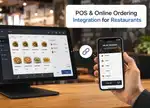
Many restaurants today rely on a Restaurant digital ordering system to manage both in-house and online customer demand without adding extra pressure on staff.
Let's simplify it.
The Real Challenges Restaurants Face Every Single Day
Restaurant owners, big or small, may face some major challenges when managing their daily business operations and functions. Some of the issues are stated below-
- Orders get mixed up during rush hours
- Staff run back and forth between tables and counters
- Inventory runs out without warning
- Owners have no clear picture of sales until the day ends
- Online and dine-in orders create confusion
These issues waste time, money, and energy. Understanding the benefits of cloud POS for restaurants helps business owners address these challenges more effectively.
This is exactly why restaurants need
cloud POS systems today. Not for growth alone, but for control and clarity, especially when handling online and offline orders through a Restaurant digital ordering system

Online Orders Made Easy
Plum POS Ensures Seamless Processing
How Cloud POS Enhances the Customer Experience
The success of restaurants today strongly relies on the customer experience. Individuals now go to restaurants not just for meals; they seek promptness, convenience, personalization, and reliability with each order. A cloud-based POS solution is essential for providing this experience seamlessly.
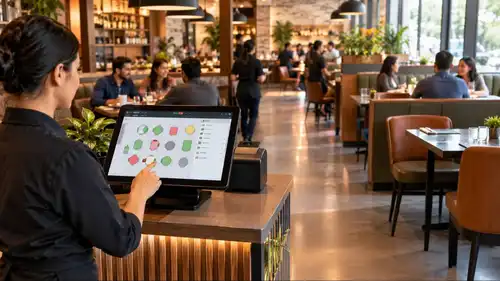
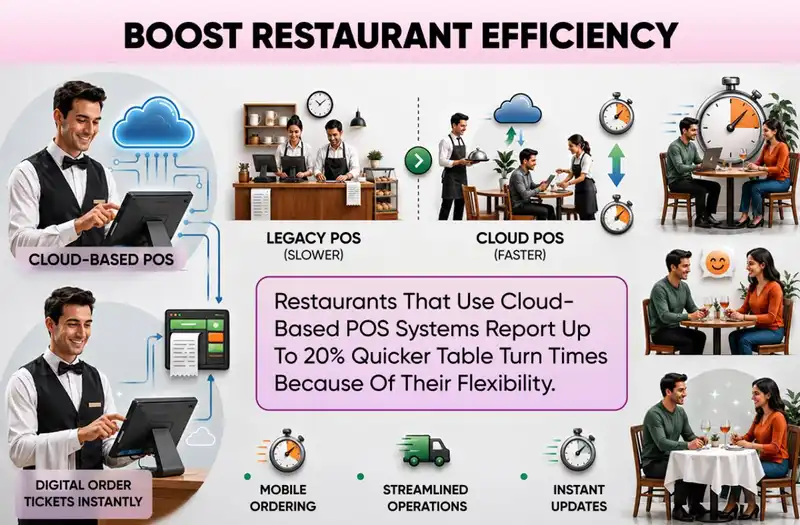
A key advantage for customers is swifter service. Orders are digitally processed and transmitted straight to the kitchen, so preparation starts nearly right away. This shortens wait times, particularly during peak hours when delays frequently occur.
A further benefit is precision in orders. When servers input orders straight into the system, the likelihood of miscommunication between the kitchen and staff decreases noticeably. Customers get precisely what they requested, fostering trust and satisfaction.
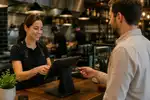
Cloud POS systems further enhance the ease of payment experiences. Visitors can settle their bills using various methods, including credit cards, digital wallets, contactless payments, or by paying in installments. This adaptability provides a contemporary and hassle-free checkout experience that consumers currently anticipate.
Moreover, cloud POS systems have the capability to save customer preferences and order history. Restaurants may utilize this data to customize their service. For instance, repeat customers may get personalized suggestions or loyalty benefits depending on their past visits.
What is a Cloud-Based POS System in Simple Terms
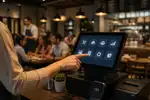
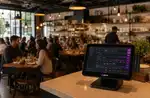
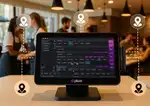
A cloud-based POS system is not just a billing machine. It is a central system that connects orders, payments, inventory, staff, and reports in one place.
The main difference is simple.
That means you can check sales, stock, and performance even when you are not physically present.
Understanding the benefits of cloud POS for restaurants makes it easier to see why these systems are becoming essential for modern operations.
Now, cloud POS systems are becoming more important than ever because of their accessibility and the benefits of POS online ordering integration across multiple sales channels.
How Cloud POS Improves Restaurant Operations Daily
You might always wonder why traditional POS takes too much time and delays the process. But now this can be improved using cloud POS.
Let's talk about how cloud POS improves restaurant operations and becomes easier when looking at daily workflows.
1) Faster and More Accurate Order Management
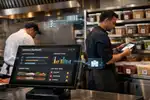
With a cloud-based POS system, servers enter orders directly into a digital system. These orders reach the kitchen instantly. There is no need for handwritten notes or repeated verbal communication.
This reduces order mistakes and speeds up preparation time. Faster service leads to better table turnover and happier customers. One of the biggest advantages here is the ability to reduce errors with POS integration during peak hours.
2) Better Inventory Visibility and Control
Inventory management is one of the biggest challenges in the restaurant business. Cloud POS systems update stock levels automatically as items are sold.
Restaurant owners can see which ingredients are moving fast and which ones are not. Low-stock alerts help avoid last-minute shortages, while accurate tracking helps reduce waste. These benefits of POS online ordering integration will directly protect profit margins and support the business.
3) Smooth Staff Coordination
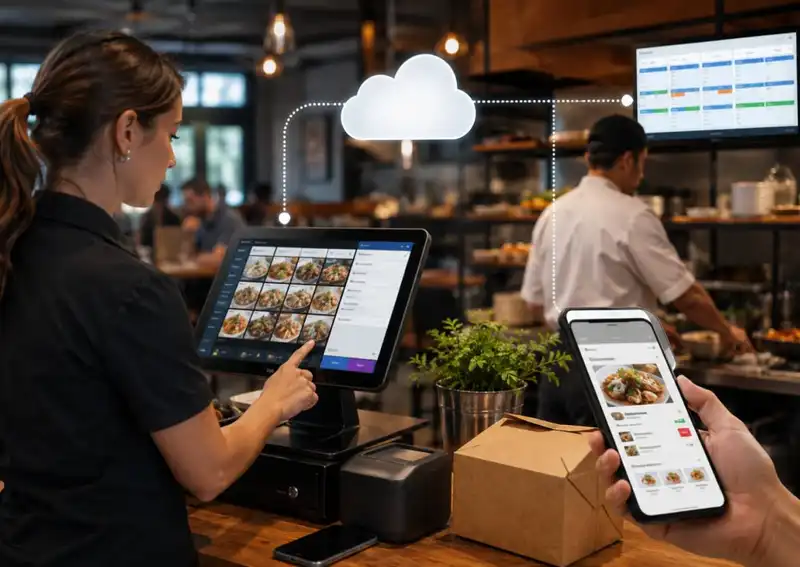
A cloud POS system improves communication between front-of-house and kitchen staff. Everyone sees the same information in real time.
Managers can also track staff performance, monitor peak hours, and plan shifts more effectively. This is another clear example of how cloud POS improves restaurant operations by creating a more organised work environment.
4) Unified View of All Orders
Modern restaurants often serve customers through multiple channels, including dine-in, takeaway, and online delivery. A cloud-based POS system brings all these orders into one platform.
This reduces confusion and ensures that no order is missed. This unified approach clearly shows why restaurants need cloud POS systems in today's multi-channel dining landscape.

From Click to Kitchen
Handle All Your Online Orders with Plum POS
Key Features of Modern Cloud-Based POS Systems
Modern cloud-based POS systems address common restaurant difficulties with features such as mobile ordering, centralized administration, offline capability, and automated security upgrades. Let's take a deeper look at how these systems are changing restaurant operations.
1) Mobile and Tabletop Ordering
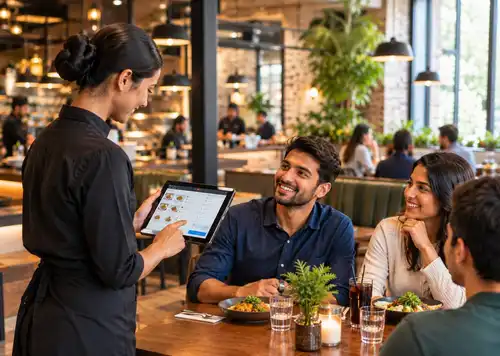
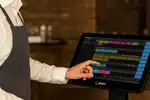
Servers may now accept orders immediately at the table using mobile devices, avoiding the need to repeatedly return to stationary terminals. These gadgets, linked to a cloud-based system, simplify the ordering process and provide a consistent experience for both employees and visitors.
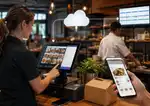
These solutions, which allow orders to be processed instantaneously from anywhere in the restaurant, therefore highlight the benefits of POS online ordering integration.
2) Managing Several Locations
Cloud-based POS solutions are very effective for managing several restaurant locations. For increasing chains, these technologies provide a single platform for overseeing operations, making scaling easier and less stressful.
With centralized administration, duties such as menu updates, pricing adjustments, and promotion launches may be done from a single dashboard across all locations. This maintains uniformity in offers, lowers training time, and gives clients a consistent experience no matter where they go.
This offline capacity assures consistent service, which is essential for client satisfaction.
Restaurants may use offline features to manage orders, generate receipts, and process payments while keeping data secure until synchronization.
3) Automatic Updates and Security
One of the most notable advantages of cloud-based POS systems is their ability to manage software upgrades automatically. Unlike older systems, which require manual upgrades and can cause downtime, these changes take place effortlessly in the background.
- Security is another significant advantage.
- Meeting security and payment compliance criteria is cited by 69% of restaurant IT decision-makers as a significant factor for selecting a contemporary POS system.
- Automatic updates guarantee that vulnerabilities are rapidly addressed, lowering the risk of malware or unwanted access.
Additional security features, including encryption, multi-factor authentication, and access limits, assist in safeguarding both consumer and corporate data.
In the case of a failure, backup and recovery tools enable crucial data to be rapidly recovered. Given the possible financial and reputational harm caused by.
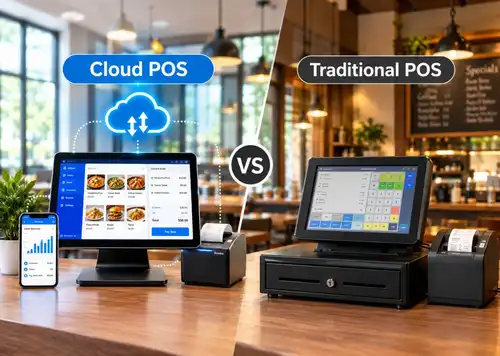
Cloud-Based POS vs. Traditional POS
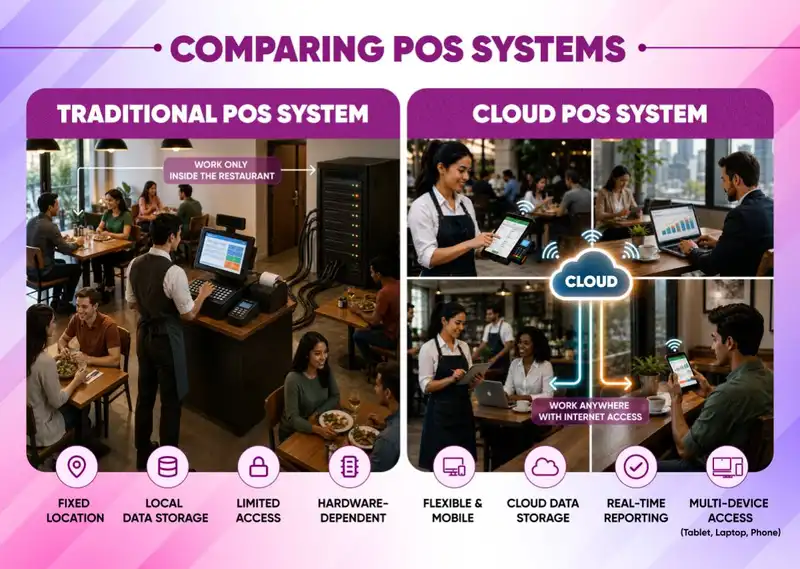
Choosing the right POS system can directly impact your restaurant's efficiency and growth. The comparison below highlights the key differences between cloud-based and traditional POS systems, helping you understand which option offers greater flexibility, lower maintenance, better security, and long-term value.
| Key Factor | Cloud-Based POS | Traditional POS |
| Cost | Low upfront cost, no expensive licenses or long-term contracts | High initial setup and software licensing costs |
| Setup & Hardware | Works on phones, tablets, or computers, no servers needed | Requires on-site servers and dedicated hardware |
| Access & Mobility | Access sales and reports from anywhere | Data is mostly tied to the physical location |
| Updates & Maintenance | Automatic updates with minimal IT effort | Manual updates and ongoing IT maintenance |
| Security | Data stored securely in the cloud with built-in compliance | Data stored locally, higher responsibility on the business |
| Scalability | Easy to add new locations or devices | Expansion requires more hardware and setup |
Who Should Invest in Cloud POS?
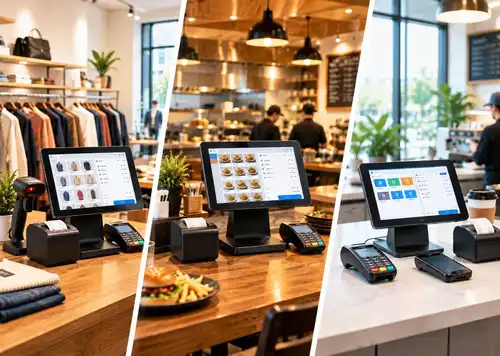
Depending on the sector, all firms can profit from a cloud POS system. Here are some instances.
A) Cloud POS for Retail
Inventory management is a common difficulty for retail organizations, and staff might spend a lot of time trying to correct inventory mistakes by physically recounting products at the store.
A cloud-based point-of-sale system for retail may drastically minimize human error while also improving retail inventory management through automation.
Sales and inventory data are synchronized and saved electronically as soon as a payment is received, allowing for improved inventory control.
B) Cloud POS for Restaurants
Restaurants with several locations should also explore cloud POS. A cloud-based restaurant POS system streamlines and centralizes data across all locations.
At any moment, business owners may view sales statistics and other vital information from each shop, as well as execute standardized system changes for all locations.
Choosing the Ideal Cloud-Based POS System for Your Restaurant
When selecting a cloud-based restaurant management system, first determine whether it is straightforward for your employees to use. The system should be designed so that employees can learn fast and operate without errors, saving time and money on training.
You should always seek a system that works well with the various technologies your business utilizes, such as payment processors, delivery applications, and accounting software. This appropriate connection helps to eliminate human effort and ensures that data is consistent across platforms.
This is an essential element for a dependable cloud-based POS system for restaurants.
Security is also necessary and crucial for your business, so select a POS system that uses strong encryption and frequent upgrades to secure your data and client information. A secure cloud-based POS system for restaurants helps to prevent hacking and data loss.
Preparing Restaurants for Future Technology Trends
The restaurant sector keeps changing swiftly. Technologies like self-service kiosks, QR-code menus, AI-powered analytics, and contactless payment options are increasingly prevalent.
Cloud-based POS systems offer the necessary flexibility to embrace these innovations.
Due to the ability of cloud platforms to connect with various digital tools, restaurants can readily incorporate new features as technology evolves.
For Example-
- Self-service kiosks can link directly to the POS system.
- Mobile ordering applications can transmit orders directly to the kitchen.
- AI analytics tools can examine sales trends for more informed decision-making.
Traditional POS systems frequently have difficulties accommodating these integrations due to their dependence on obsolete infrastructure.
Cloud-based systems, on the other hand, are intended to develop in tandem with the restaurant sector.
Final thoughts
Running a restaurant today is no longer just about good food and great service. It is about speed, accuracy, control, and the ability to adapt every single day. A cloud-based POS system supports all this quietly in the background, without adding complexity to your operations.
From managing orders and inventory to coordinating staff and handling multiple sales channels, a cloud POS combined with a restaurant digital ordering system brings everything into one clear, connected system. It gives restaurant owners real-time visibility, reduces daily errors, and delivers the long-term benefits of POS online ordering integration that modern restaurants need to stay competitive.

Accept, Process, and Profit with Ease!
Streamline Your Online Orders with Plum POS














-Benefits-&-POS-Guide-150-90faf61de.webp)