How can a POS help my restaurant manage tips fairly?
It logs every tip by order, employee, and shift, then splits pools automatically. That means fewer disputes and cleaner payroll records.
POS systems
Updated On: October 22, 2026 | Published On: October 22, 2026 |

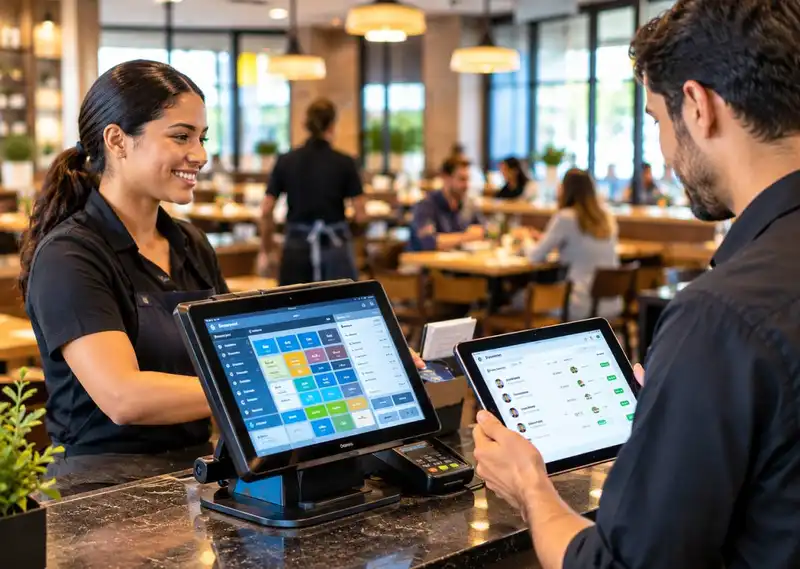
It logs every tip by order, employee, and shift, then splits pools automatically. That means fewer disputes and cleaner payroll records.
Every shift ends with the same question- who earned what in tips? When restaurants rely on manual math, mistakes creep in. A missed dollar here, a miscounted shift there, and before long, you're dealing with payroll errors, frustrated staff, or a compliance headache you didn't see coming.
This is exactly where a good POS system earns its keep. Modern POS platforms track tips as they come in, split them according to your rules, and maintain a clean record for payroll and reporting. In this article, we'll walk through what tips and gratuities actually are, how they differ, where "service charge" fits into the picture, and how restaurant tip management in a POS system helps you stay organized, fair, and compliant.
Tip" and "gratuity" are often used interchangeably, but they're not quite the same thing. Here's how they actually differ.

A tip is what a customer chooses to leave after a meal. A few things make tips what they are-
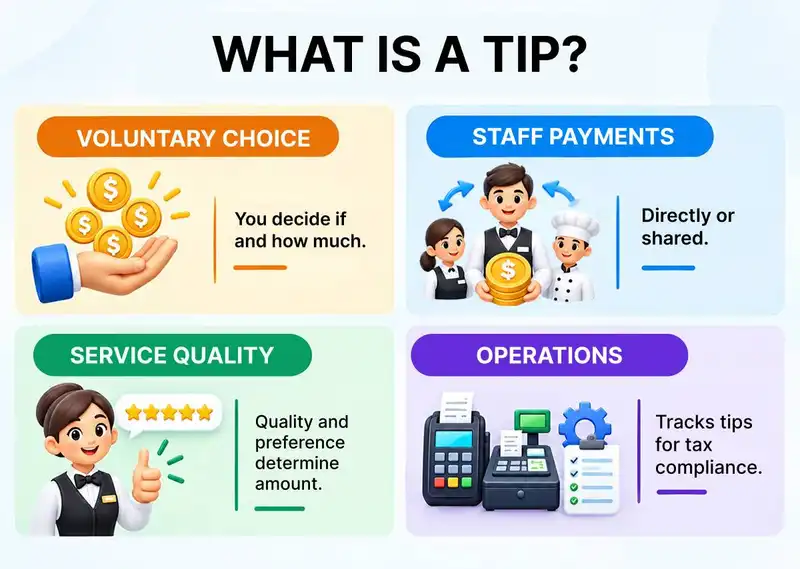
Cash isn't the only way tips show up anymore. Customers today might leave a tip through-

A gratuity, on the other hand, is a set charge the restaurant adds to the bill. A few defining features-
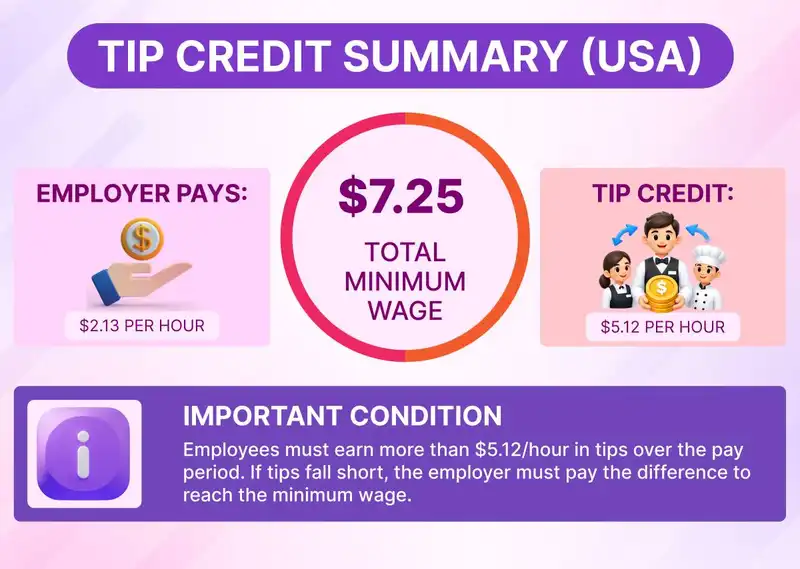
Not quite. The core difference is that tips are optional and gratuities aren't. That distinction also affects how each is taxed and handled, though the specifics depend on where you operate, so it's worth checking your local and state rules or talking to a tax professional rather than assuming one rule applies everywhere.
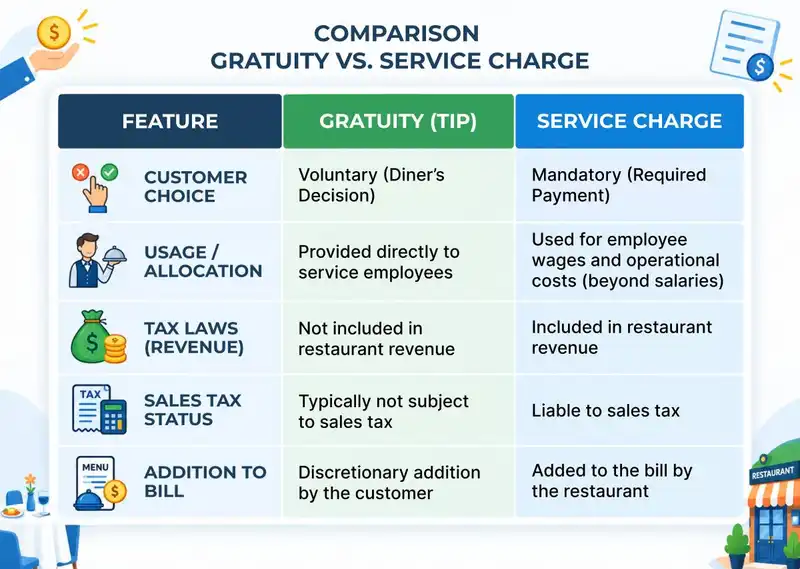
A few other differences worth knowing-
Some restaurants add a "service charge" instead of, or alongside, a gratuity which can make things even more confusing for customers and staff alike.
A service charge is a fee the restaurant adds to cover the cost of service more broadly. Depending on the restaurant's policy, that money might go toward staff pay, or it might cover other operating costs. Like a gratuity, it's mandatory; the customer doesn't get to opt out.
Because rules around how service charges must be disclosed and taxed differ by location, restaurants should confirm the requirements that apply to them rather than assume a single standard applies everywhere.
There's no single right answer here; it depends on your restaurant's priorities, your team, and your local labor laws. A few things worth weighing-
Steadier pay- A built-in gratuity can give staff more predictable income instead of a paycheck that swings with foot traffic and mood.
Service incentives- Voluntary tipping can push staff to go the extra mile, since their pay is tied to how customers feel. A mandatory gratuity removes some of that incentive, though it also protects staff from a bad night that isn't their fault.
Being upfront with customers- Hidden or unclear fees are a fast way to lose trust. If you're charging a gratuity or service fee, make sure it's clearly stated on the menu and the bill.
Fair distribution- When a restaurant collects gratuities, it takes on the responsibility of splitting them fairly. Voluntary tips, by contrast, usually go directly to the person who earned them.
There are also legal angles worth checking before you settle on a policy-
Plenty of restaurants pool tips so that everyone who contributes to the customer experience, not just the server, gets a share. Instead of each server keeping their own tips, the money goes into a shared pool and gets split according to a set formula.
Here are the three models you'll see most often, along with where each tends to work best.
Every eligible employee gets an equal slice of the pool.
Best for- Smaller restaurants where roles overlap, and everyone pitches in across the board.
Each role gets assigned a point value based on its responsibilities. For example-
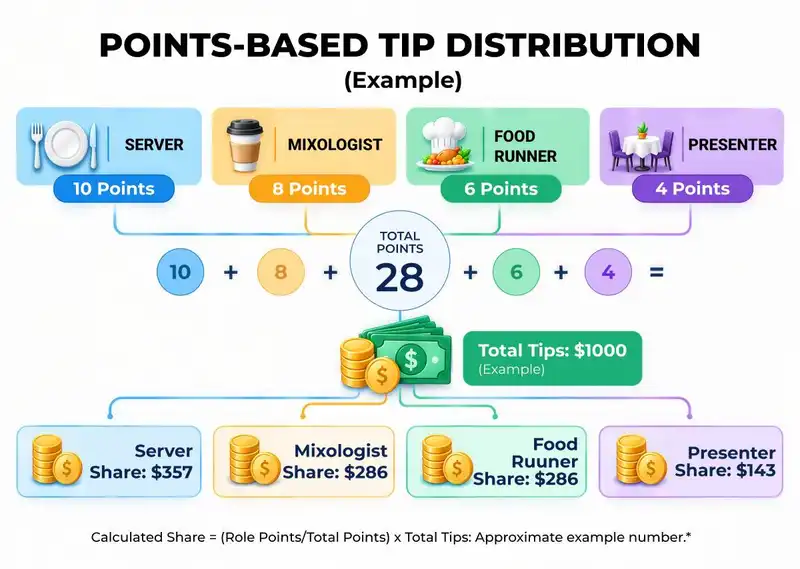
Here, each role gets a fixed percentage of the pool. For example-
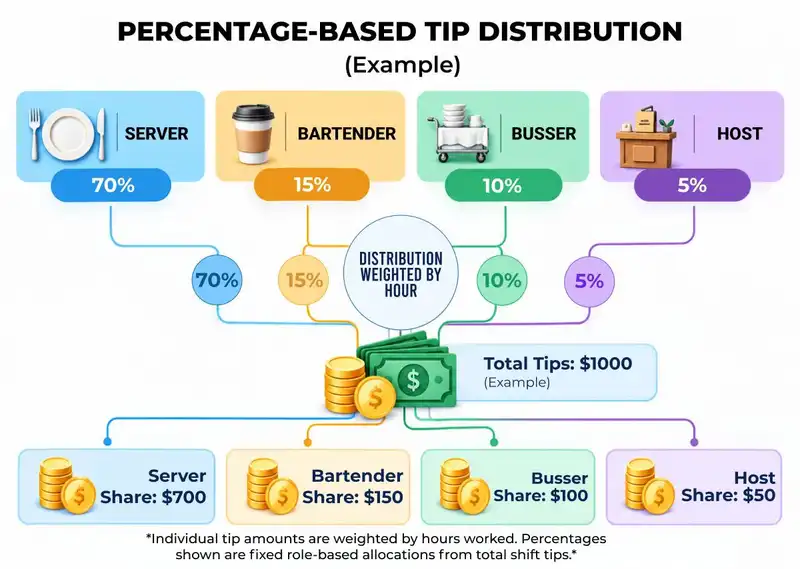
Plum's tip pooling feature takes the manual math out of the equation, cutting down on errors and making sure everyone gets paid fairly. It works with point-based pools, percentage-based pools, and optional hour-weighting, so it adapts to whatever service model you run.
Tipping is standard in this industry, but managing it well isn't always simple. Some of the most common sticking points-
Disagreements over distribution- When job duties overlap, staff don't always agree on how tips should be split, especially if the process isn't clearly explained.
Cash vs. digital tips- Cash is harder to track than a digital payment. Without solid records, it's tough for managers to confirm what each employee actually took home.
Shift-to-shift differences- Multi-shift restaurants need a fair way to split tips across teams, since a busy dinner rush usually brings in more than a slow Tuesday afternoon.
Staying compliant- Accurate tip records matter for payroll taxes and reporting. Getting this wrong can mean penalties or a rough audit down the line.
Customer confusion- When service charges, automatic gratuities, and voluntary tipping aren't explained clearly, customers can end up feeling like they're being charged twice.
A well-set-up POS system takes a lot of this off your plate by enforcing consistent rules and doing the math automatically.
Tipping culture keeps shifting, and so does the technology behind it. A few trends worth watching-
Tips and gratuities both matter to restaurant staff, but they work differently in how they're given, taxed, and controlled. Tips are optional and tied to service; gratuities are set by the restaurant and mandatory. Getting this right takes clear policies, awareness of the laws that apply to you, and a POS system that handles tip tracking, distribution, and reporting accurately. Get that combination right, and you'll keep things transparent for both your team and your customers.










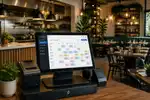





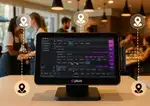


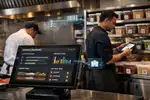





































POS systems automatically track gratuities included with cash, card, or digital transactions. They assist restaurants in monitoring tip totals by employee, shift, and transaction, enhancing the accuracy of distribution and reporting.
Yes. Most modern POS systems let you set up tip pooling rules based on hours worked, job role, percentage share, or a points system.
Accurate tip tracking keeps payroll records clean and supports tax compliance. It also helps ensure staff are paid fairly and reduces disputes among team members.
In many cases, a service charge or automatic gratuity is meant to cover the service itself. That said, some customers still choose to leave something extra if they felt the service went above and beyond.
Yes, most systems let you set your own gratuity rates, pooling structures, and distribution rules to match how your restaurant actually operates.
2026-10-12
Read More